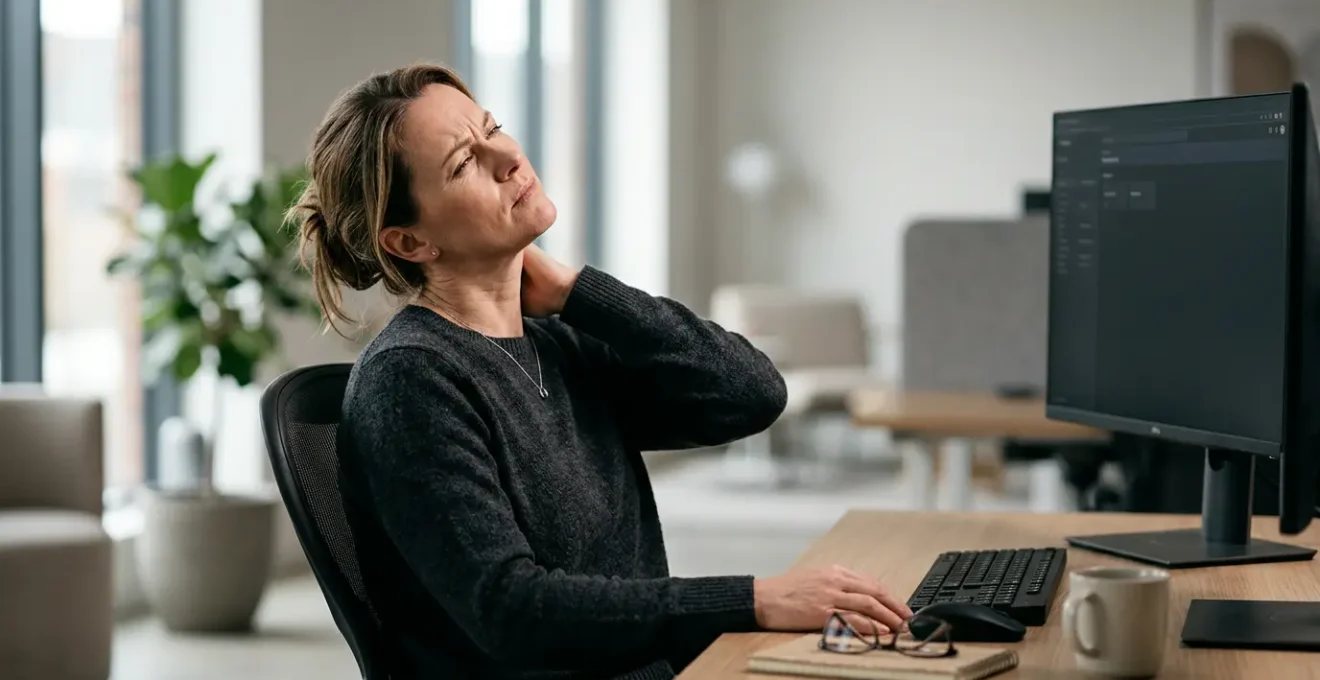
Your chronic neck pain isn’t random; it’s a direct result of your body compensating for presbyopia.
- Avoiding proper eyewear forces your head into unnatural tilts, creating constant cervical strain.
- Cheap “ready readers” often have the wrong optical center, worsening headaches and poor posture.
Recommendation: A proper eye exam and task-specific lenses are not just about vision—they are critical tools for preventing long-term musculoskeletal damage.
That ache in your neck. The stiffness in your shoulders after a day at the computer. You blame stress, a bad night’s sleep, or just “getting older.” But what if the real culprit is right in front of your face? Or more accurately, what if it’s the fact that you’re constantly pushing things away from your face to read them? This habit—holding your phone at arm’s length, leaning back from your monitor—is a classic sign of presbyopia, the natural loss of near-focusing ability that happens to everyone starting in their 40s.
Most people think of presbyopia as a simple inconvenience, a problem for their eyes alone. They delay getting glasses, relying on squinting, brighter lights, or cheap pharmacy readers. From a postural therapist’s perspective, this is a critical mistake. Your denial isn’t just causing eye strain; it’s triggering a destructive biomechanical chain reaction. Your body, in its attempt to find a clear focal point, will sacrifice its alignment. This forced adaptation, or postural compensation, is the real source of your physical pain.
The solution isn’t just about seeing clearly. It’s about stopping the physical damage before it becomes chronic. This article isn’t about optometry; it’s about biomechanics. We will dissect the direct link between avoiding proper vision correction and developing persistent neck and back pain. We’ll explore why cheap solutions often make the problem worse and how the right lenses can be one of the most effective ergonomic tools you own.
To fully understand this connection, we will break down the physiological changes in your eyes, the postural consequences of ignoring them, and the specific, practical steps you can take to protect your body. This guide provides a clear path to managing your aging vision without sacrificing your physical well-being.
Contents: Understanding the Link Between Your Eyes and Neck Pain
- Why Can’t Your Eye Muscles Focus Close Up After Age 45?
- How to Adjust Monitor Height When Wearing Your First Progressives?
- Varifocals or Occupational Lenses: Which Is Better for 8 Hours of Desk Work?
- The “Ready Reader” Trap: Why Cheap Glasses Might Cause Headaches?
- When to Use a Directed Task Light to Delay the Need for Stronger Glasses?
- Why Does the Floor Look Curved When You First Wear New Glasses?
- Why Do Pastel Colours Become Invisible to Seniors With Yellowing Lenses?
- Adapting the Home for Aging Eyes: How to Prevent Falls for Seniors?
Why Can’t Your Eye Muscles Focus Close Up After Age 45?
The frustration of not being able to read a menu in a dim restaurant or see your phone’s notifications clearly is not a failure of your eye muscles. It’s a mechanical issue. Inside your eye is a natural lens, known as the crystalline lens. In your youth, this lens is soft and flexible, easily changing shape to focus on objects at different distances. As we age, this lens gradually thickens and loses its elasticity. It becomes harder and less willing to bend.
This hardening process is called presbyopia. It’s a universal and inevitable part of aging. According to the American Optometric Association, the condition is incredibly common, affecting nearly 90% of adults over age 45. When you try to look at something up close, your eye muscles (the ciliary muscles) contract as they always have, attempting to squeeze the lens into a more convex shape. However, the now-rigid lens resists. It can no longer bend light sufficiently to focus it correctly onto the retina at the back of your eye.
The crystalline lens at the front of the eye loses its elasticity over time, making it harder for light to pass through the eye to bend and form an image on the retina.
– American Optometric Association, Clinical Eye Care Brief on Presbyopia
The result is blurry near vision. It’s not that your muscles are weak; it’s that they are pulling on a component that has lost its flexibility. This is why no amount of “eye exercise” can reverse presbyopia. It’s a physical property change, and the only solution is to provide an external lens—in the form of glasses—to do the light-bending work your internal lens no longer can.
How to Adjust Monitor Height When Wearing Your First Progressives?
Once you accept the need for glasses, many opt for progressive lenses (or varifocals) for their convenience, offering distance, intermediate, and near vision in one lens. However, they introduce a new ergonomic challenge, especially for desk work. A progressive lens is mapped with distance vision at the top, intermediate in the middle, and reading at the very bottom. This design is what triggers the classic “chin-lift” posture.
Standard ergonomic advice tells you to position the top of your monitor at or slightly below eye level. For a varifocal wearer, this is a disaster. To see the screen clearly, you would have to look through the intermediate or reading portion of your lens, forcing you to tilt your head back constantly. This sustained cervical extension is a direct path to neck pain, shoulder tension, and headaches. The solution is counter-intuitive: you must lower your monitor significantly.
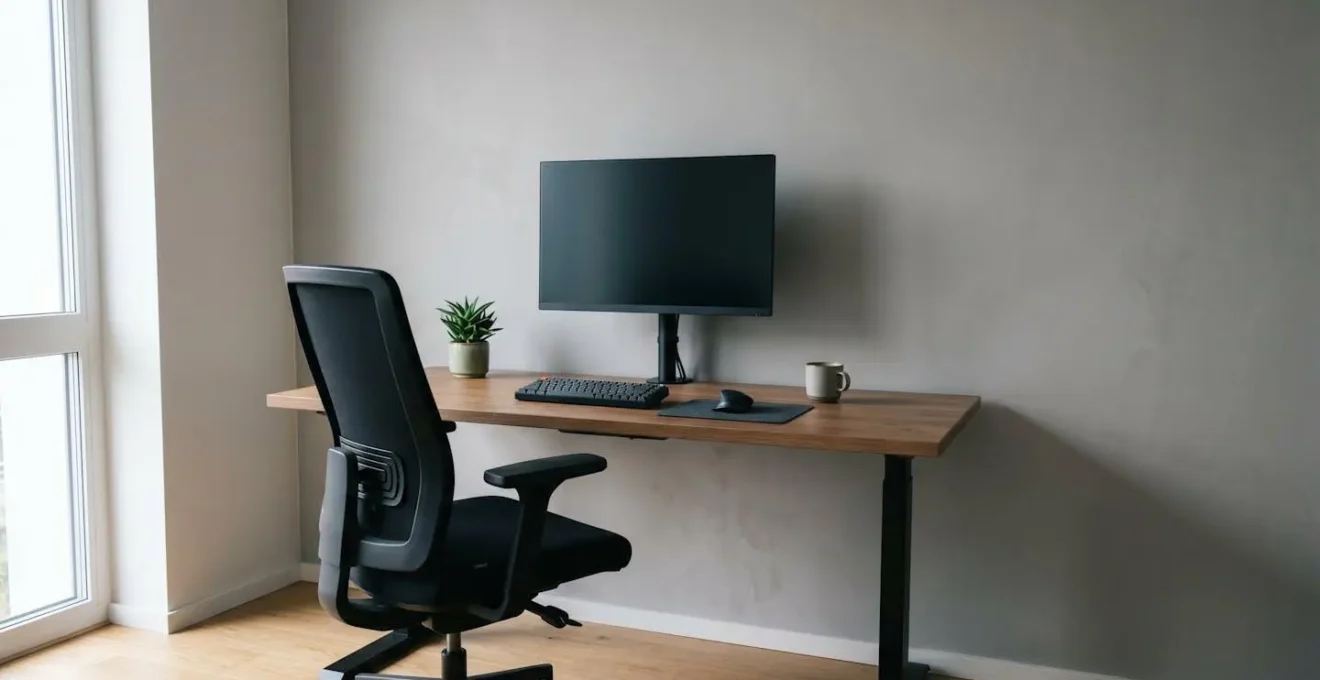
As the illustration shows, the goal is to position the screen so that your eyes naturally view it through the correct part of the lens while maintaining a neutral neck posture. Your nose should point directly at the area of the screen you are focused on. You then make micro-adjustments by tucking or lifting your chin, not by craning your neck. The viewing distance should also be considered, typically between 400-750 mm, and you might need to increase the font size on your screen to find a comfortable distance that doesn’t force you into the very bottom of the lens.
Varifocals or Occupational Lenses: Which Is Better for 8 Hours of Desk Work?
While standard progressive lenses are a jack-of-all-trades, they are often a master of none, particularly in an office environment. The intermediate-vision corridor in a standard varifocal lens is notoriously narrow. As you scan across a wide monitor or look from your screen to a document, your head must constantly move side-to-side to keep the content within this tiny “sweet spot.” This leads to muscle fatigue and strain.
This is where occupational lenses, also known as computer or office lenses, become a superior tool. These lenses are specifically designed for desk work. They dedicate a much larger portion of the lens to intermediate vision (for the monitor) and near vision (for your keyboard and desk). A randomized controlled trial found that specialized VDU lenses provide significantly wider intermediate zones, drastically reducing the need for head-tilting and a strained posture.
Workplace Study: The Postural Cost of Standard Progressives
A Spanish workplace health study by FREMAP used motion capture to analyze office workers. It found that those wearing standard progressive lenses maintained a consistent neck extension that exceeded recommended ergonomic limits. This chronic postural strain was directly linked to their need to constantly look through the lower portion of the lenses. When workers switched to occupational lenses designed for desk distances, the technology confirmed this damaging posture was eliminated, as the larger intermediate zone allowed for a neutral head position.
The choice is a functional one. If you spend more than a few hours a day at a computer, a dedicated pair of occupational lenses is not a luxury; it’s a crucial piece of ergonomic equipment. It directly addresses the primary cause of postural pain for presbyopic desk workers by removing the need for the body to compensate for a lens not built for the task.
The “Ready Reader” Trap: Why Cheap Glasses Might Cause Headaches?
In the early stages of presbyopia denial, the easiest “fix” seems to be a pair of cheap, over-the-counter reading glasses, or “ready readers.” While they might bring text into focus, they often create a new set of problems that lead directly to headaches and further postural strain. The primary issue is that these glasses are one-size-fits-all, and our faces are not.
The most critical measurement they ignore is your pupillary distance (PD)—the exact distance between the centers of your pupils. For glasses to work correctly, the optical center of each lens must be perfectly aligned with your pupils. In ready readers, the PD is set to a generic average. If your PD is wider or narrower than this standard, your eyes are forced to strain inwards or outwards to look through the correct part of the lens. This misalignment is a significant source of discomfort, as optician customer support analysis reveals that incorrect PD is the single most reliable cause of eye fatigue complaints.
This constant, low-level muscle strain is a direct trigger for headaches, dizziness, and visual fatigue. Furthermore, because the magnification is uniform across the entire lens, you can only see clearly at one specific distance. This forces you into a “postural trap,” where you must constantly move your head forward and back to find the sweet spot, further aggravating your neck and shoulders. A properly prescribed pair of glasses, by contrast, is custom-made for your unique PD and visual needs, eliminating this primary source of strain.
When to Use a Directed Task Light to Delay the Need for Stronger Glasses?
Before you even reach for glasses, one of the most powerful and often overlooked tools for managing early presbyopia is light. You’ve likely noticed that it’s easier to read in bright sunlight than in a dimly lit room. This isn’t a coincidence; it’s a principle of optics. Your pupil, the opening that lets light into your eye, constricts in bright light and dilates in dim light.
A smaller pupil creates a “pinhole effect,” which increases your eye’s depth of field. This is the same principle a camera uses: a smaller aperture (like your constricted pupil) keeps more of the scene, both near and far, in sharper focus. By strategically using a bright, directed task light on your reading material or workspace, you can manually force your pupils to constrict, effectively sharpening your near vision without any lenses at all.

This isn’t just an anecdotal trick; it’s a recognized physiological mechanism. As explained in a clinical review from the Journal of Current Research, “Bright light helps by reducing pupil size, increasing depth of field, and allowing some people to read without glasses.” Using a flexible desk lamp to illuminate your book or keyboard, rather than just relying on a general overhead room light, can make a significant difference. It allows you to maintain a comfortable, upright posture instead of hunching over to get closer to a dim light source. While it won’t stop presbyopia, good lighting is a powerful, non-invasive tool to maximize your natural vision and delay the need for stronger prescriptions.
Why Does the Floor Look Curved When You First Wear New Glasses?
One of the most disorienting experiences for a new progressive lens wearer is looking down and seeing the floor appear to swim, curve, or tilt. This “fishbowl effect” is a normal and expected part of the adaptation process. It’s caused by the peripheral distortion inherent in the complex curvature of varifocal lenses. Your brain, which has spent decades interpreting visual signals from your uncorrected eyes, is suddenly receiving a completely new type of data. It doesn’t know how to process these new curves and distortions yet.
The key thing to understand is that this is a brain adaptation issue, not an eye issue. Your brain needs time and consistent input to create a new “map” of the world as seen through your new lenses. Trying to “fight” it or immediately taking the glasses off will only prolong the process. The good news is that adaptation is almost always successful; clinical data shows an over 98% success rate for wearers who persevere through the initial period. With consistent wear, your brain will learn to ignore the peripheral distortions and the “curved floor” effect will disappear, usually within a few days to a couple of weeks.
To speed up this process, you must retrain your head and eye movements. Instead of darting your eyes around, you need to point your nose directly at what you want to see clearly and move your whole head. This ensures you are always looking through the optimal central corridor of the lens. Specific, simple exercises can help build this muscle memory faster.
Your Action Plan: Adapting to New Progressive Lenses
- Point Your Nose: Don’t move your eyes to see at different distances. Instead, move your head and point your nose where you need to look.
- Be Consistent: Give yourself enough time to adapt. Keep wearing your lenses consistently during the adaptation phase, though you can take them off briefly for a break.
- Practice Scanning: Practice specific exercises like sitting and slowly scanning a room, or holding onto a counter while looking down through the reading portion at your feet.
- Give it Time: It might take days or even a few weeks for your brain to fully adjust to the new visual information provided by your varifocal lenses.
Why Do Pastel Colours Become Invisible to Seniors With Yellowing Lenses?
Another subtle change that occurs with age is a shift in color perception, which is also caused by the aging of the crystalline lens. Over many years, the proteins within the lens can start to yellow, a process similar to how clear plastic might yellow in the sun over time. This yellowing isn’t typically noticeable from day to day, but it has a cumulative effect on how you see color.
The yellowed lens acts as a permanent, built-in yellow or brown filter. This filter is particularly effective at blocking short-wavelength light, which includes colors like blues, greens, and violets. As a result, these colors can appear duller, darker, or be difficult to distinguish from one another. This is why a navy blue sock can look identical to a black one in a dimly lit room for an older person.
This effect is most pronounced with low-contrast colors. Bright, bold colors like a fire-engine red or a vibrant yellow remain easy to see. However, subtle pastel shades—like a pale lavender, a soft mint green, or a baby blue—can become almost invisible. Their low saturation and reliance on the blue end of the spectrum means they are effectively “filtered out” by the yellowing lens, often appearing as a generic shade of grey or off-white. Understanding this helps explain why high-contrast environments are so crucial for maintaining visual function in later years.
Key Takeaways
- Your body’s attempt to compensate for poor vision by tilting your head is the primary cause of neck pain, not the eye strain itself.
- Standard progressives are not designed for prolonged desk work and can enforce poor posture; occupational lenses are a superior ergonomic tool.
- Cheap “ready readers” often cause headaches and postural strain due to incorrect pupillary distance alignment.
Adapting the Home for Aging Eyes: How to Prevent Falls for Seniors?
The consequences of age-related vision changes extend far beyond neck pain and color perception. In the home environment, declining visual acuity, reduced contrast sensitivity, and increased glare sensitivity can create significant safety hazards, with falls being the most serious risk. Adapting the home isn’t just about convenience; it’s a critical preventative health measure.
Lighting is the single most impactful modification. As the eye’s lens yellows and the pupil becomes less responsive, much more light is needed to see clearly. However, simply adding one powerful overhead light can create intense glare, which is equally debilitating. The solution is to use multiple, lower-intensity light sources to create well-lit “zones” and pathways. For tasks, validated experimental research demonstrated that a bright, cool light (around 75 foot-candles at 6000K) provides optimal comfort and performance.
Contrast is the other key pillar of a visually safe home. With diminished color perception, identifying edges and changes in elevation becomes difficult. This is why high-contrast visual cues are so effective. Applying matte, non-slip tape to the edge of each stair, using different colored doormats at every threshold, and ensuring that furniture stands out from the color of the floor and walls can provide the clear landmarks the aging eye needs to navigate safely. Finally, reducing glare by replacing glossy floor tiles with matte surfaces and using sheer curtains to diffuse harsh sunlight can prevent moments of temporary blindness that often lead to trips and falls.
Take control of your postural health. A comprehensive eye exam is not just about clearer vision—it is the first and most critical step toward achieving a pain-free neck and a healthier posture for years to come.