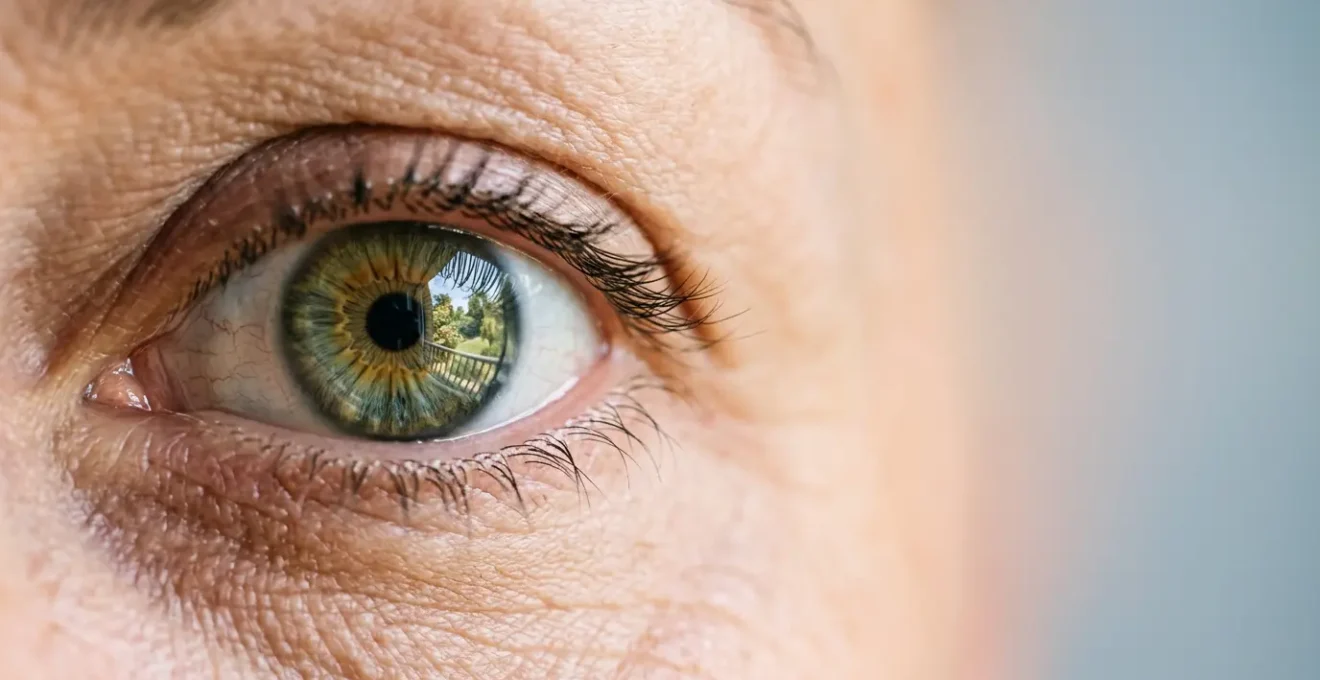
Viewing Refractive Lens Exchange (RLE) as a simple medical expense is a fundamental mistake; it’s a strategic capital investment in your future quality of life.
- The procedure’s ‘cost’ is offset by eliminating the recurring ‘tax’ of glasses and contacts.
- Premium lenses are not a luxury but a tool to match your visual performance to your lifestyle goals.
Recommendation: Evaluate your options not on price alone, but on the long-term ‘lifestyle dividend’ and financial freedom you will gain.
For those over 45, the creeping frustration of presbyopia is a universal experience. The constant search for reading glasses, the difficulty with a restaurant menu, the slight blur on a phone screen—it’s a daily tax on convenience and spontaneity. While many have heard of laser eye surgery, it’s often not the optimal solution for this age-related decline in near vision. The conversation then turns to other options, often mentioning standard cataract surgery as a benchmark.
However, this framing misses the fundamental opportunity. The real question isn’t just about fixing a problem; it’s about making a strategic upgrade to a critical personal asset: your vision. What if the solution wasn’t just to see clearly again, but to enhance your visual capability for decades to come? Refractive Lens Exchange (RLE) should not be viewed as a mere medical procedure, but as a significant investment in your long-term ‘visual capital’ and lifestyle portfolio.
This analysis will treat RLE with the seriousness of a financial prospectus. We will dissect the underlying asset depreciation (the aging lens), compare the performance of different investment options (premium lenses), quantify the return on investment by calculating the true ‘cost of waiting’, and manage the known risks (side effects) to help you determine if this high-value procedure aligns with your personal and financial goals. It’s time to move beyond the simple question of “Can I get rid of my glasses?” and ask the more profound one: “What is the long-term value of investing in a lifetime of visual freedom?”
To help you navigate this significant decision, this guide is structured to address the key financial, practical, and lifestyle questions. Explore the sections below to build your comprehensive understanding.
Contents: Analysing Your RLE Investment
- Why Do Trifocal Implants Cause Halos Around Lights initially?
- How Is RLE Different From Standard Cataract Surgery on the NHS?
- Extended Depth of Focus or Trifocal: Which Gives Better Intermediate Vision for PC Work?
- The “Perfect Vision” Myth: Why You Might Still Need Reading Glasses for Micro-Print?
- When to Use 0% Finance Plans to Spread the Cost of Surgery?
- Standard or Premium Lenses: Which Implant Fits Your Retirement Lifestyle?
- Why Can’t Your Eye Muscles Focus Close Up After Age 45?
- When to Book Cataract Surgery: The 3 Signs Your Daily Life Is Compromised?
Why Can’t Your Eye Muscles Focus Close Up After Age 45?
The gradual loss of near vision after the age of 40, known as presbyopia, is often misunderstood. It is not a failure of the eye’s muscles. Instead, it’s a fundamental change in the physical properties of the natural lens inside your eye. Think of the lens in your twenties as flexible, like soft jelly. The tiny ciliary muscles surrounding it could easily change its shape, allowing you to shift focus seamlessly from a distant horizon to the words on a page.
However, with age, this lens progressively hardens and loses its elasticity. As one expert resource explains, it’s a case of the lens hardening “like setting jelly,” so the muscle can no longer change its shape. The ‘motor’ still works perfectly, but the lens itself has become unresponsive. This mechanical limitation is why no amount of eye exercise can reverse presbyopia. The issue is not muscular weakness but the depreciation of a physical asset.
Refractive Lens Exchange directly addresses this core problem. Instead of trying to work with a hardened, inefficient asset, the procedure replaces it entirely with a new, high-performance artificial lens. This is why clinical guidelines indicate RLE is often recommended for individuals aged 40 or older experiencing this exact issue—it is a permanent solution to a mechanical failure.
How Is RLE Different From Standard Cataract Surgery on the NHS?
While both RLE and cataract surgery involve the same highly refined surgical technique—replacing the eye’s natural lens—their underlying philosophy, purpose, and financial model are fundamentally different. Conflating the two is a common but critical error in evaluating the procedure’s value. NHS cataract surgery is a medical necessity; private RLE is a strategic lifestyle enhancement.
The NHS procedure’s goal is to restore functional vision lost to a clouded lens (the cataract). Because it is medically necessary, it is funded by the public health system. In contrast, RLE is performed on a clear but dysfunctional lens to achieve spectacle independence—an elective choice to improve quality of life. This distinction is the primary driver of cost differences, as outlined by a comparative analysis from Bluefin Vision.
| Aspect | NHS Cataract Surgery | Private RLE |
|---|---|---|
| Primary Goal | Restore functional vision lost to cataract (medical necessity) | Enhance vision for spectacle independence (lifestyle choice) |
| Lens State | Cloudy lens affecting vision | Clear but functionally limited lens |
| Standard Lens Offered | Monofocal (single distance focus) | Premium multifocal/trifocal options |
| Funding Model | NHS funded (medically necessary) | Private pay (elective procedure) |
| Post-Op Expectation | Clarity restored, often with reading glasses | Multi-distance vision, minimal glasses dependence |
| Typical Cost | Free at point of care (NHS) | £4,200-£5,200 per eye (approx.) |
As the medical team at Bluefin Vision notes, “RLE and cataract surgery use the same surgical technique, but their cost structures differ because they serve different purposes.” The NHS provides a monofocal lens, which typically corrects distance vision but leaves the patient dependent on reading glasses. Private RLE offers an investment in premium multifocal or trifocal technology, designed to provide clear vision across multiple distances, thereby maximising your visual capital.
Extended Depth of Focus or Trifocal: Which Gives Better Intermediate Vision for PC Work?
Once you’ve decided to invest in RLE, the next critical decision is selecting the right technology. This is not a “one-size-fits-all” choice; it’s about matching the lens’s performance profile to your specific lifestyle demands. For professionals and active individuals, a key battleground is intermediate vision—the exact range required for comfortable computer use, viewing a car dashboard, or seeing a presentation.
The two leading premium options are Extended Depth of Focus (EDOF) and Trifocal lenses. As the minimalist workspace below illustrates, a typical day involves multiple, distinct visual zones that place different demands on your eyes. Your ability to seamlessly transition between a document on your desk, your monitor, and a colleague across the room is paramount.

A trifocal lens has three distinct focal points (near, intermediate, distance), offering excellent sharpness at each point but with the potential for noticeable transitions between zones. An EDOF lens, by contrast, creates a continuous, elongated focal point, providing a smoother visual experience from intermediate to distance, though potentially less powerful at very close near vision. This performance matrix is crucial for anyone whose work is screen-dependent.
The following performance breakdown, based on clinical data from the London Cataract Centre, provides a clear framework for this decision. Pay close attention to the trade-offs between sharpness at different distances and the potential for night-time visual disturbances.
| Performance Metric | EDOF Lens | Trifocal Lens |
|---|---|---|
| Sharpness at Near (40cm) | Moderate (may need readers for fine print) | Excellent (dedicated near focal point) |
| Sharpness at Intermediate (60-80cm) | Excellent (smooth, wide working zone) | Very Good (fixed intermediate point at ~60cm) |
| Sharpness at Distance | Excellent | Excellent |
| Halo/Glare Intensity (Night) | Low to Moderate | Moderate to High (12.6% report severe halos) |
| Contrast Sensitivity | Higher (less light scatter) | Slightly Reduced (light split 3 ways) |
| Smoothness of Transition | Very Smooth (continuous range) | Discrete zones (may notice ‘jumps’) |
| Computer Work Suitability | Ideal (wide intermediate range, flexible posture) | Good (if monitor at optimal ~60cm distance) |
| Spectacle Independence | 73% for near tasks | 90%+ for all distances |
As the clinical team at the London Cataract Centre summarises, “If your priority is seamless reading and computer work without glasses, trifocals generally come out ahead. But if you value computer productivity, depth perception and a more natural visual feel, EDOF lenses may be the better match.” The choice depends entirely on which ‘performance metric’ you prioritise for your daily life.
Why Do Trifocal Implants Cause Halos Around Lights initially?
Any sound investment analysis requires a clear-eyed assessment of risk and potential downsides. For premium trifocal lenses, the most frequently discussed side effect is the initial appearance of halos or starbursts around lights, particularly at night. Understanding the cause of this phenomenon is key to managing expectations and seeing it for what it is: a temporary adjustment period, not a permanent flaw.
This visual effect is a direct result of the sophisticated optics of the lens. A trifocal lens works by splitting light into three distinct focal points to provide clear vision at near, intermediate, and distance. In low-light conditions, your pupil naturally dilates (widens) to let in more light. This larger pupil allows light to pass through all the concentric rings of the multifocal lens simultaneously, which can cause the perception of halos.

The critical point, however, is that this is not a permanent state. The brain possesses a remarkable ability to adapt, a process known as neuroadaptation. Over time, your brain effectively learns to ignore the extraneous light information from the halos and focus on the clearest image. As the CollaborativeEYE research team states, “The good news is that the brain adapts to seeing these halos.”
Crucially, this adaptation occurs within a predictable timeframe. Research demonstrates that over the first 3 to 6 months after surgery patients undergo neural adaptation so that they notice halos less and less. For the vast majority of patients, halos become a non-issue as their new visual system fully calibrates, leaving them with the significant benefit of multi-distance vision.
The “Perfect Vision” Myth: Why You Might Still Need Reading Glasses for Micro-Print?
A high-quality investment delivers on its promises, and a core promise of RLE is freedom from glasses. However, it’s crucial to define that promise with precision. The goal is spectacle independence for the vast majority of daily activities, not the literal restoration of the vision you had at age 18. Setting realistic expectations is the bedrock of patient satisfaction.
Leading surgeons are clear on this point. As London-based eye surgeon Alex Shortt explains, “It is necessary, however, that patients understand that no treatment can restore the same vision they had at age 18.” The natural human lens has a dynamic range of focus that no current technology can perfectly replicate. This means that in certain challenging situations—such as reading extremely fine print on a medicine bottle, in a dimly lit room, or after hours of intense near work—a pair of simple reading glasses might occasionally be helpful.
This is not a failure of the procedure. On the contrary, achieving complete freedom for 95% or more of your visual needs is a phenomenal success. Clinical data from leading UK eye surgeons confirms that RLE offers a 95% chance of being wholly spectacle-free for daily life. This means no more searching for glasses to read your phone, drive your car, see a menu, or work at your computer. The trade-off—a potential need for reading glasses for 5% of niche tasks—is one that most patients consider an outstanding return on investment.
Standard or Premium Lenses: Which Implant Fits Your Retirement Lifestyle?
The distinction between ‘standard’ and ‘premium’ lenses is not about luxury; it is about performance matching. The most important question to ask is: what are the primary visual demands of my current and desired lifestyle? Choosing the right lens is akin to choosing the right tool for the job. A monofocal lens (the ‘standard’ option in many contexts) is an excellent tool for one specific task, typically providing clear distance vision. A premium multifocal or EDOF lens is a versatile multi-tool, designed for a dynamic life.
Consider these retirement personas to identify your primary needs:
- The Avid Golfer or Sailor: Your priority is elite distance vision to see the fairway or the horizon. Scorecard or chart reading is secondary. A premium monofocal lens set for distance, combined with occasional reading glasses, can provide the best possible contrast and clarity for your main activity.
- The Passionate Hobbyist: Your life revolves around near and intermediate tasks like painting, model-building, reading, or crafts. A trifocal lens, offering dedicated sharp focal points, would provide the seamless, glasses-free experience you need to be fully immersed in your passions.
- The Globetrotting Grandparent: Your life is unpredictable. You need to switch effortlessly between reading menus, seeing your grandchildren’s faces, checking travel documents, and taking in the sights. An EDOF lens, with its smooth visual range and low visual disturbances, offers maximum flexibility for these variable environments.
Even in demanding professional contexts, successful adaptation is common. One published case study detailed a 59-year-old nighttime truck driver who, despite concerns about halos, proceeded with PanOptix trifocal lenses. One month post-surgery, his vision was better than 20/20 at all ranges, and he continued to drive comfortably at night. This demonstrates that the right premium lens, combined with neuroadaptation, can deliver exceptional performance even under challenging conditions.
When to Use 0% Finance Plans to Spread the Cost of Surgery?
Refractive Lens Exchange is a significant capital outlay. With costs ranging from £4,200 to £5,200 per eye according to Moorfields Private pricing data, a total investment of £8,400 to £10,400 requires careful financial planning. For many, 0% finance plans offered by clinics are an attractive vehicle for managing this expense, allowing the cost to be spread over 12, 24, or 36 months without incurring interest.
The decision to use financing should be a strategic one, based on an analysis of cash flow and the “cost of waiting.” Delaying the procedure is not a zero-cost option. You continue to pay a “tax” in the form of annual spending on prescription glasses, contact lenses, and appointments, not to mention the intangible cost of lifestyle compromises. A 0% finance plan allows you to start reaping the “lifestyle dividend” of clear vision immediately, while paying for it with future, inflation-devalued money.
However, entering into a finance agreement requires due diligence. It is essential to understand the terms, potential penalties, and impact on your credit profile. The following framework provides a structured way to evaluate whether a 0% finance plan is the right tool for your financial situation.
Your Financial Audit: The Cost of Waiting vs. Acting Now
- Calculate annual cost: Add up yearly spending on new prescription glasses (£200-400), multifocal contact lenses (£300-600), and eye care appointments.
- Quantify intangible costs: Document instances where vision limitations prevented spontaneous activities (night driving, reading menus, sports) over the past 6 months.
- Compare to monthly finance payment: Divide total surgery cost (e.g., £8,400 for both eyes) by 24-36 months to see the monthly commitment (£233-350/month on a 0% plan).
- Check finance terms: Verify there are zero hidden fees, confirm what happens if a payment is missed (e.g., retroactive interest rates), and check the impact on your credit score.
- Apply inflation-beating logic: Recognize that a £8,400 cost paid over 24 months has less real-terms value than paying the full amount today, especially in an inflationary environment.
Key Investment Takeaways
- RLE is a lifestyle investment, not a medical cost; evaluate its ROI in terms of quality of life.
- Lens choice is critical: match the technology (Trifocal, EDOF) to your specific daily demands (PC work, hobbies).
- Spectacle independence is highly likely (~95%), but not guaranteed for all tasks; manage expectations for a successful outcome.
When to Book Cataract Surgery: The 3 Signs Your Daily Life Is Compromised?
For a clear lens exchange, the question is not “when do I need surgery?” but rather “when does the investment in better vision deliver the highest return?” The optimal time to act is when the cumulative ‘cost of waiting’—both financial and emotional—outweighs the cost of the procedure. The decision point is reached when you notice your vision is not just a nuisance, but a tangible barrier compromising your quality of life. There are three critical signs that the balance has tipped and surgical intervention is the logical next step.
These signs are less about clinical metrics and more about your daily experience:
- The Confidence Crisis: This is when you begin to avoid situations not because you can’t see, but because you lack the confidence to do so. You might decline invitations to drive at night or visit a dimly lit restaurant. You’re not just missing out; you are actively self-limiting your life due to visual uncertainty.
- The Participation Tax: Daily activities that should be effortless now require constant management and mental energy. Swapping between multiple pairs of glasses, holding menus at arm’s length, or struggling to check your phone becomes a source of mounting frustration. You are paying an ‘energy tax’ on normal life.
- The Best Corrected Vision Plateau: You visit your optometrist for a new prescription, only to find that it offers minimal improvement. When your best-corrected vision no longer meets your functional needs and lifestyle ambitions, the problem has shifted from a simple refractive error to a dysfunctional lens that requires a surgical solution.
When these compromises become your daily reality, the investment in RLE transitions from a ‘nice-to-have’ to a clear necessity for reclaiming your life. The procedure offers an extremely high probability of success in this regard; clinical outcomes from Moorfields Eye Hospital demonstrate that 95% of patients achieve vision of driving standard or better, effectively eliminating the primary barriers to confidence and participation.
The data is clear: the cost of inaction is a daily tax on your confidence and participation. When your best-corrected vision no longer serves your lifestyle ambitions, the logical next step is to schedule a consultation to build a personalised visual performance plan.