
Contrary to the old belief of waiting for a cataract to be “ripe,” the right time for surgery is when your vision starts compromising your safety and the joy of your active lifestyle.
- The decision is not based on a single eye chart test but on functional decline in real-world situations like night driving or enjoying hobbies.
- Modern 15-minute procedures offer high success rates and recovery is quick, allowing a swift return to activities like gardening or golf.
Recommendation: Use this guide’s three benchmarks to self-assess your visual function and have an informed, confident conversation with your ophthalmologist about reclaiming your visual independence.
That familiar glare from oncoming headlights seems sharper than before, turning night drives into a tense experience. Reading the fine print on a medicine bottle requires more light and effort. You might dismiss these as normal signs of aging, but they are often the first whispers of a developing cataract. For many active seniors, the idea of surgery is daunting, leading to a “wait and see” approach. The common advice is to wait until your vision is “bad enough” or until the cataract is “ripe”—an outdated concept that can unnecessarily prolong a life lived in a deepening fog.
The crucial shift in thinking is this: the question is not “How bad does my vision have to get?” but rather, “How much of my active, independent life am I willing to compromise?” Cataract surgery today is not a last resort for near-blindness. It is a proactive, low-risk procedure designed to restore not just sight, but visual confidence. It’s about ensuring you can continue to drive safely at night, enjoy your hobbies with precision, and move around your home without the heightened risk of a fall.
This guide moves beyond generic advice. As a consulting ophthalmologist, my goal is to empower you with a clear framework. We will explore the specific, real-world signs that indicate your daily life is being compromised. We’ll demystify the remarkably efficient modern surgery, discuss how to choose an implant that matches your retirement lifestyle, and map out a clear path to a swift recovery. The goal is to replace apprehension with informed confidence, so you can decide when it’s the right time to reclaim the crisp, vibrant world you deserve.
This article provides a structured path to understanding when the benefits of cataract surgery outweigh the risks of waiting. We will cover everything from the initial signs of visual compromise to the specifics of recovery, giving you a complete picture to inform your decision.
Summary: When to Book Cataract Surgery: The 3 Signs Your Daily Life Is Compromised?
- Why Night Driving Becomes Dangerous Long Before You Feel Blind?
- How Does Modern Cataract Surgery Restore Vision in Under 15 Minutes?
- Standard or Premium Lenses: Which Implant Fits Your Retirement Lifestyle?
- The “Ripe Cataract” Myth That Delays Necessary Treatment for Years
- When Can You Resume Gardening and Sports After Cataract Procedure?
- Why Does the Eye Lens Harden and Cloud Over With Age?
- Why Do Trifocal Implants Cause Halos Around Lights initially?
- Adapting the Home for Aging Eyes: How to Prevent Falls for Seniors?
Why Night Driving Becomes Dangerous Long Before You Feel Blind?
One of the first and most critical signs that a cataract is compromising your daily life is a decline in night-driving ability. This isn’t just about seeing halos or starbursts around lights, although those are classic symptoms. The more insidious issue is a loss of contrast sensitivity. This is your eye’s ability to distinguish objects from their background, which is crucial for seeing a pedestrian in dark clothing, spotting a pothole on a poorly lit road, or judging the distance of other cars. A standard eye chart in a brightly lit office measures visual acuity (sharpness), but it can’t detect this subtle, dangerous loss.
As a cataract clouds the natural lens, it scatters light instead of focusing it cleanly onto the retina. This scattering effect dramatically reduces contrast, making the world appear washed out, especially in low-light conditions. You may find yourself squinting, slowing down unnecessarily, or feeling a general lack of visual confidence behind the wheel after dusk. You might be able to pass a driving test in broad daylight, yet be functionally impaired at night. This discrepancy is a major red flag.
Recognizing this specific functional loss is a key benchmark. As ophthalmology research points out, real-world visual performance is often better predicted by this metric than by standard acuity tests. As the ARVO Journals Research Team highlights, “Contrast sensitivity is often used in clinical studies for evaluating visual function, because impairment in real-world visual performance is better predicted by a contrast-sensitivity test than by high-contrast VA measurements.” When your ability to navigate your environment safely at night is diminished, your cataract is no longer a minor inconvenience; it has crossed a critical safety threshold.
How Does Modern Cataract Surgery Restore Vision in Under 15 Minutes?
The thought of eye surgery can be intimidating, often conjuring images of long, complex operations. However, modern cataract surgery is one of the most refined, successful, and quickest procedures performed today. The entire process, from entering the operating room to leaving it, is typically completed in under 15 minutes per eye. It’s a testament to incredible technological advancement, designed for patient comfort and rapid visual recovery.
The standard technique is called phacoemulsification. It is not painful; your eye is completely numbed with anesthetic drops, and you may be offered a mild sedative to help you relax. The surgeon makes a micro-incision, often as small as 2.2 millimeters, at the edge of the cornea. A tiny probe is inserted, which uses high-frequency ultrasound waves to gently break the cloudy lens into microscopic pieces, which are then suctioned out. This part of the process is the “phacoemulsification.” The delicate membrane, or “capsular bag,” that held your natural lens is left perfectly intact.
This paragraph introduces the concept of modern cataract surgery. To better understand the precision involved, the illustration below highlights the micro-incision technique.
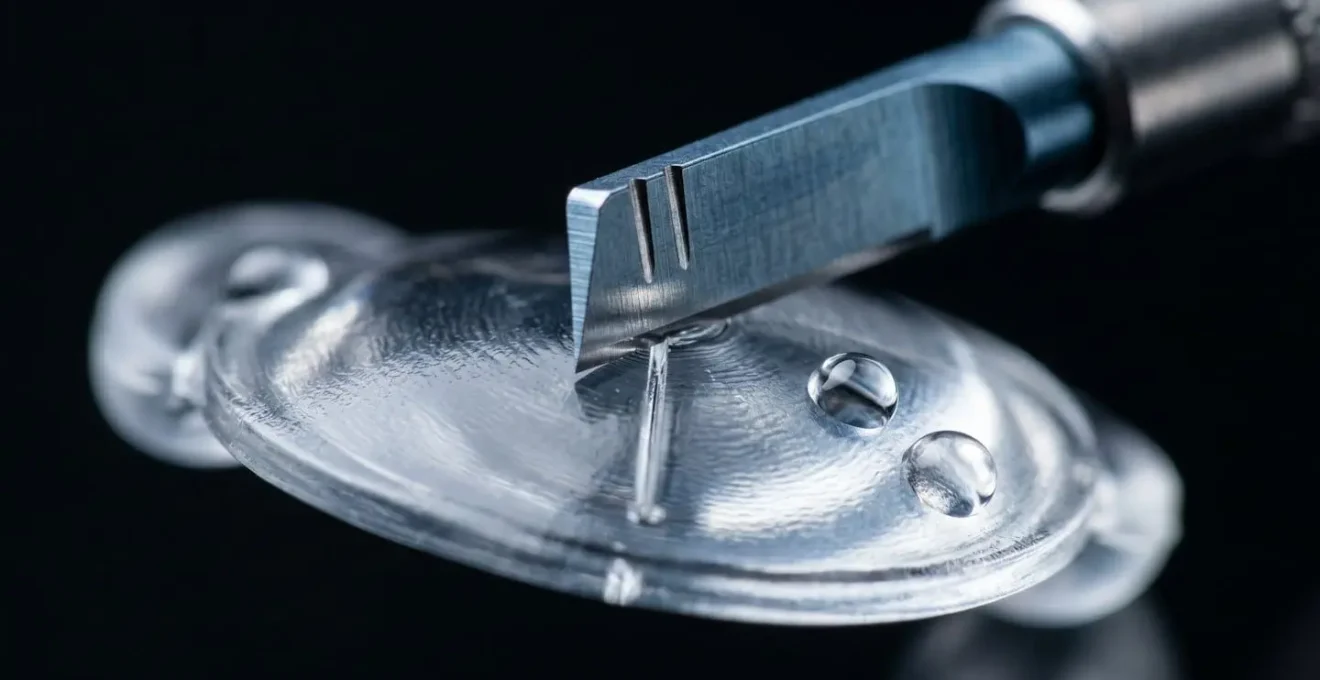
Once the cloudy lens is removed, a new, clear artificial intraocular lens (IOL) is folded and injected through the same micro-incision. Inside the eye, it unfolds into position within the capsular bag, where it will remain permanently. The incision is so small it is self-sealing and rarely requires stitches. The procedure’s success is remarkable; a 2024 clinical cohort study found that 96.1% of eyes achieved excellent visual acuity post-surgery. This high level of success and minimally invasive nature are key reasons why there is no need to delay treatment and endure declining vision.
Standard or Premium Lenses: Which Implant Fits Your Retirement Lifestyle?
Once you’ve decided on surgery, the next conversation is about your new lens. This isn’t just a medical choice; it’s a lifestyle decision. The goal is to select an intraocular lens (IOL) that best matches your daily activities and goals for your retirement. Do you want the freedom to read a book, check your phone, and see distant landscapes without glasses? Or are you comfortable wearing reading glasses as long as your distance vision for driving or watching TV is crystal clear? The technology now exists to cater to these specific desires.
The main categories are Monofocal, EDOF (Extended Depth of Focus), and Trifocal lenses. Monofocal lenses are the standard option, designed to provide excellent vision at a single focal point, usually distance. They are a fantastic choice for individuals whose priority is clear distance vision and who don’t mind using glasses for near tasks like reading. Premium lenses, such as EDOF and Trifocal IOLs, are designed to reduce or eliminate the need for glasses by providing clear vision at multiple distances.
The following table breaks down how each lens type aligns with different lifestyle profiles, helping to clarify which might be the best fit for you.
| IOL Type | Vision Range | Spectacle Independence | Ideal Lifestyle Profile | Visual Phenomena |
|---|---|---|---|---|
| Monofocal | Single distance (usually far) | Low – glasses needed for near/intermediate | Low-Maintenance Traveler, Avid Driver | Minimal halos/glare |
| EDOF (e.g., Vivity) | Distance to intermediate (~26 inches) | Moderate – reading glasses may be needed | Tech-Savvy Grandparent, Golfer | Near-absent glare and halos |
| Trifocal (e.g., PanOptix) | Near, intermediate, and distance | High – most activities without glasses | Passionate Reader/Crafter | Noticeable halos (29% vs 8% monofocal) |
Surgeons can even employ advanced strategies to maximize visual outcomes, as seen in this clinical example.
Case Study: The “Mix-and-Match” Vision Strategy
A recent clinical approach detailed in a review of ophthalmology practices involved implanting a Trifocal IOL in a patient’s non-dominant eye (for strong near vision) and an EDOF IOL in the dominant eye (for excellent distance and intermediate vision with minimal halos). The results were outstanding: 100% of patients achieved 20/25 or better distance vision, and 90% achieved the same for near vision. Crucially, very few patients were bothered by halos or glare, demonstrating a highly customized and successful outcome.
The “Ripe Cataract” Myth That Delays Necessary Treatment for Years
One of the most persistent and damaging myths in ophthalmology is the idea that you must wait for a cataract to become “ripe” or “mature” before it can be removed. This notion is a holdover from decades ago, when surgical techniques were far cruder. Today, with modern phacoemulsification, the opposite is true: it is safer and easier for the surgeon to remove a cataract in its earlier stages. Waiting serves no medical purpose and only prolongs the period of declining vision and its associated risks.
Delaying surgery allows these cloudy formations to progress, resulting in a gradual and substantial decline in vision. The longer you wait, the harder it can be for the surgeon to remove the cataract.
– Neoretina Eye Hospital Research Team, Risks Associated with Postponing Cataract Surgery
Delaying surgery isn’t a passive act; it has tangible consequences that compromise your health and safety. The gradual loss of vision, especially in contrast and depth perception, directly increases the danger of accidents. In fact, a systematic review found that patients waiting more than 6 months for cataract surgery experienced not only more vision loss and a reduced quality of life but also a significantly increased rate of falls. A fall for a senior can be a life-altering event, leading to fractures, loss of independence, and other serious health complications.
The decision to proceed with surgery should be made when the cataract begins to interfere with your ability to live your life safely and fully. If you are struggling with night driving, finding it difficult to enjoy hobbies like reading or sewing, or feeling less stable on your feet, your cataract is ready for removal. Waiting for it to get “worse” simply means accepting an unnecessary period of compromised function and increased risk. The “ripe” cataract is a myth that belongs to a bygone era of surgery.
When Can You Resume Gardening and Sports After Cataract Procedure?
A primary concern for active seniors is how long recovery will take and when they can return to the activities they love. The good news is that recovery from modern cataract surgery is remarkably swift. While your vision may be clear almost immediately, it’s important to follow a few simple guidelines to ensure a smooth and safe healing process. The goal is a steady, progressive return to your normal routine, allowing your eye to heal properly without strain.
In the first week, the focus is on protection. You will be using prescribed eye drops to prevent infection and reduce inflammation. It is crucial to avoid rubbing or touching your eye. You’ll likely be advised to wear a protective shield at night and sunglasses outdoors. Strenuous activities and heavy lifting are off-limits during this initial period. However, light activities around the house, watching television, and reading are perfectly fine. Most people can resume driving within a few days, once cleared by their surgeon.
The return to more active hobbies is gradual and typically begins within a few weeks. Here is a general timeline you can expect:
- Week 1: Avoid touching your eyes and protect with sunglasses or a shield outdoors. Refrain from heavy lifting or strenuous activities like weightlifting or intense exercise.
- Week 2-3: Light gardening activities may resume, but you should avoid bending over at the waist to reduce pressure on the eye.
- Week 3-4: You can begin a gradual return to sports like golf (starting with putting and chipping) and tennis (gentle volleys before full matches).
- Throughout recovery: Use prescribed medicated eye drops exactly as directed to prevent infection and reduce inflammation. This is the most critical step for a successful outcome.
This timeline allows your brain and eyes to adapt, restoring not just clarity but also the depth perception essential for many activities.

The key is to listen to your body and your surgeon’s advice. By following these simple guidelines, you can expect to be back to your favorite sports, hobbies, and a fully active lifestyle within a month, enjoying the world with renewed color and clarity.
Why Does the Eye Lens Harden and Cloud Over With Age?
A cataract is not a “film” that grows over your eye; it’s a natural aging process that happens inside your eye. To understand it, think of the eye’s natural lens. When you are young, this lens is perfectly clear, soft, and flexible, much like a tiny, transparent droplet of gelatin. This flexibility allows it to change shape easily, focusing light onto the retina so you can see objects clearly at all distances, from a book in your hands to a sign down the road.
The lens is made mostly of water and precisely arranged proteins. With age, these proteins begin to change. They can start to clump together, creating small cloudy areas within the lens. This is the beginning of a cataract. At first, these clumps are tiny and may not affect your vision. But over years, they grow larger and more numerous, causing the entire lens to become progressively more opaque and yellow or brown. This clouding process scatters the light passing through the lens, which is what causes the signature symptoms of blurry vision and glare.
Simultaneously, the lens also becomes harder and less flexible. This hardening is a separate but related age-related process called presbyopia, which is why most people need reading glasses starting in their 40s. As a cataract develops, this loss of flexibility is compounded by the loss of clarity. This is an extremely common condition; studies indicate that cataracts affect almost half of the population aged over 60. It is a normal, expected part of the eye’s aging journey, not a disease you “catch.” Understanding this can help demystify the condition and frame it as a manageable part of life that, fortunately, has an excellent and permanent solution.
Why Do Trifocal Implants Cause Halos Around Lights initially?
One of the main questions patients have about premium lenses like trifocal IOLs is about visual phenomena, specifically halos or glare around lights at night. It’s an important topic to understand. These effects are not a complication or a sign that something is wrong; they are an inherent part of how these advanced lenses work, and for the vast majority of people, they fade into the background over time through a remarkable process called neuroadaptation.
A trifocal lens works by splitting light into three distinct focal points to give you clear vision at near, intermediate, and far distances. The lens surface has a series of microscopic, concentric rings that direct the light accordingly. When a bright light source, like a headlight, hits these rings, some of the light is scattered, creating the perception of a halo. It’s a trade-off: in exchange for the incredible benefit of being glasses-free for most activities, the brain has to learn how to process this new type of visual information.
This is where neuroadaptation comes in. Your brain is incredibly plastic and adaptable. For the first few weeks or months after surgery, your brain is actively learning to interpret the new signals from your eye. It has to figure out which information is “important” (the primary image) and which is “noise” (the halo). Over time, it simply learns to ignore the halos, tuning them out so they are no longer noticeable or bothersome. This is the same process that allows you to tune out the feeling of a watch on your wrist or the sound of a refrigerator humming.
Neuroadaptation—your brain’s adjustment to new visual input usually takes 3-6 months. Patients gradually adapt to any original visual phenomena like halos or glare during this time.
– Dr. CT Pillai, Precision Vision London IOL Comparison Guide
Patience is key during this period. While it can be disconcerting at first, the brain’s ability to adapt is powerful. When patients are properly counseled and know what to expect, the process is very manageable, and clinical data shows a 90% success rate for multifocal IOLs in terms of patient satisfaction. It’s also worth noting that some patients barely notice halos at all, while for others, they are more prominent initially before fading away.
Key takeaways
- The right time for cataract surgery is when vision loss impacts your safety and daily activities, not when a cataract is “ripe.”
- Modern phacoemulsification is a 15-minute procedure with a high success rate, making prolonged waiting unnecessary.
- Choosing an IOL is a lifestyle decision; premium lenses can significantly reduce or eliminate the need for glasses post-surgery.
Adapting the Home for Aging Eyes: How to Prevent Falls for Seniors?
While planning for cataract surgery, it’s crucial to address the immediate safety risks posed by your current, compromised vision. The most significant of these is the risk of falls. Reduced depth perception, poor contrast sensitivity, and blurry vision create a perfect storm for accidents in the home. According to research from Johns Hopkins Medicine, impaired vision from cataracts increases the risk of falls, especially in older adults. Taking proactive steps to adapt your home environment is not just a good idea; it’s an essential part of preparing for surgery and ensuring your safety in the interim.
Think of this as a pre-surgery safety mission. Your goal is to increase contrast and improve lighting to compensate for what your eyes can no longer do effectively. Simple changes can make a world of difference. Start by assessing the most hazardous areas: staircases, hallways, and bathrooms. Poor lighting is the primary culprit in many falls. Replacing dim bulbs with brighter, higher-quality LED bulbs can instantly improve visibility. Look for bulbs with a high CRI (Color Rendering Index) of 90+ and a color temperature in the 3000-4000K range, which provides clear, natural-looking light.
Beyond lighting, focus on eliminating tripping hazards. Loose rugs, electrical cords snaking across floors, and general clutter are all potential dangers. A thorough “pathway purge” to clear main walkways is a simple but highly effective measure. In the bathroom, non-slip mats in the tub or shower and securely installed grab bars are non-negotiable safety features. The following checklist can serve as your guide to conducting a home safety audit before your vision is restored.
Your pre-surgery home safety audit checklist
- Apply high-contrast, non-slip tape on the edge of all stairs (especially top and bottom steps).
- Replace all dim bulbs with high-CRI (Color Rendering Index 90+) LED bulbs in the 3000-4000 Kelvin range.
- Install layered lighting: ambient (ceiling), task (reading lamps), and accent (pathway night lights).
- Conduct a ‘pathway purge’ to remove tripping hazards like loose rugs, electrical cords, and clutter.
- Ensure the bathroom has securely installed grab bars and non-slip mats before surgery.
By understanding these key benchmarks of compromised function, you can move from a state of anxious waiting to one of empowered decision-making. Scheduling a consultation with an ophthalmologist is the definitive next step to assess your specific situation and create a personalized plan to restore your vision, safety, and quality of life.