
That unsettling dizziness or “fishbowl” feeling with new glasses is alarming, but it’s usually caused by a predictable conflict between your eyes and brain, not necessarily a major error.
- Most symptoms stem from your brain adapting to new visual information, a process called visual-vestibular recalibration that can take a few days.
- Persistent issues often point to specific, correctable measurement errors, such as an incorrect Pupillary Distance (PD) or a mismatched lens Base Curve.
Recommendation: Understand the difference between normal adaptation symptoms and red flags for an error. This knowledge will empower you to have a productive conversation with your optician to get the crisp, comfortable vision you paid for.
That initial moment of putting on new glasses should be one of clarity and relief. Instead, you might be experiencing something far more disconcerting: the floor seems to curve upwards, straight lines look bent, and a wave of dizziness or a headache begins to set in. This experience is not only common but also deeply unsettling, leading many to worry that their prescription is drastically wrong or that something is amiss with their vision. While it’s easy to fall back on generic advice like “just give it time,” this doesn’t address the legitimate anxiety you feel. You deserve to understand exactly what is happening from a clinical perspective.
The reality is that your brain is a powerful processing unit that has spent years, or even decades, accustomed to a specific way of seeing the world—either with no correction or with your old prescription. Introducing a new set of lenses, even with a technically perfect prescription, is like changing a fundamental rule in its operating system. The resulting dizziness and distortion are often symptoms of a temporary “software update” as your brain recalibrates. However, these feelings can also be a clear signal of a quantifiable error in the lens manufacturing or measurements.
But if the real issue isn’t just “your brain,” but rather a specific, measurable aspect of your new eyewear? The key to resolving this discomfort and anxiety lies not in passively waiting, but in actively understanding the optical principles at play. This guide will move beyond the platitudes and empower you with the knowledge of a clinical optometrist. We will dissect the precise reasons for that “fishbowl” effect, explore how to check for critical measurement errors yourself, and provide a clear framework for when to patiently adapt and when to confidently return to your optician for a re-check. We will explore the science behind the visual-vestibular conflict, the crucial role of the optical center, the impact of lens design and base curve, and how to decode your own prescription to become an informed advocate for your vision.
This article provides a structured path to understanding your new eyewear. The following summary outlines the key areas we will cover to help you distinguish normal adaptation from a genuine problem.
Summary: Understanding and Resolving New Glasses Discomfort
- Why Does the Floor Look Curved When You First Wear New Glasses?
- How to Check If Your Optical Center Is Aligned With Your Pupils?
- Aspheric or Spherical: Which Lens Design Reduces the “Fishbowl” Effect?
- The Base Curve Mistake: Why Changing Frame Shape Causes Eye Strain?
- When to Go Back to the Optician If Your Headache Won’t Go Away?
- What Do the Plus and Minus Signs Actually Mean for Your Vision?
- Why Does a Wrong PD Cause Headaches With Strong Prescriptions?
- How to Read Your NHS Optical Prescription Without Being an Optometrist?
Why Does the Floor Look Curved When You First Wear New Glasses?
That disorienting sensation of the floor appearing curved or the feeling of being slightly off-balance is clinically known as the “fishbowl effect.” This is not a sign of a faulty prescription itself, but rather a direct symptom of your brain’s adjustment to a new visual reality. It is caused by something called visual-vestibular conflict. Your vestibular system, located in your inner ear, is responsible for your sense of balance and spatial orientation. It works in constant communication with your eyes to keep your world stable as you move.
New glasses, especially those with a significant change in prescription or a different lens design, alter the magnification and peripheral view of your world. When you turn your head, your brain has a pre-calculated expectation of how much the visual scene should move. Your new lenses change this input. For a brief period, what your eyes are seeing doesn’t perfectly match what your inner ear’s balance system is reporting. This mismatch is the same phenomenon that causes motion sickness. Your brain is essentially saying, “The data from the eyes doesn’t match the data from the balance system. Something is wrong!”
Case Study: The Brain’s Recalibration Process
The vestibular system controls eye movements through a mechanism called the vestibulo-ocular reflex (VOR), which keeps your gaze steady when your head moves. A specific ratio exists between head movement and the necessary eye movement to maintain stability. New glasses alter this finely calibrated relationship. Your brain must essentially “re-learn” this ratio to adapt to the new visual input. This process of recalculation is what causes the temporary disorientation, dizziness, and the curved-floor sensation until a new, stable equilibrium is established.
For most people, the brain is remarkably quick to adapt. This recalibration period is the “adjustment” everyone talks about. The key is consistent wear. Switching back and forth between your old and new glasses will only confuse your brain and prolong the adaptation process. By wearing the new pair exclusively, you provide your brain with the consistent data it needs to build a new, accurate model of your visual world.
How to Check If Your Optical Center Is Aligned With Your Pupils?
While brain adaptation is common, some issues are due to a concrete measurement error. The single most important measurement for clear, comfortable vision is the alignment of the Optical Center (OC) of each lens directly in front of your pupil. The OC is the point on the lens that has the truest power, with zero unwanted prism. If your pupils are not looking through this precise point, your brain is forced to correct for induced prismatic effects, leading directly to eye strain, headaches, and a feeling of being “pulled” to one side.
This alignment depends on an accurate Pupillary Distance (PD) measurement—the distance between your pupils. While your optician measures this, errors can happen. You can perform a simple at-home check to see if the OCs on your glasses are reasonably aligned with your pupils. This test won’t replace a professional measurement, but it can be a powerful indicator of a potential problem. This visual check can give you the confidence to know if you need to go back for a re-measurement.
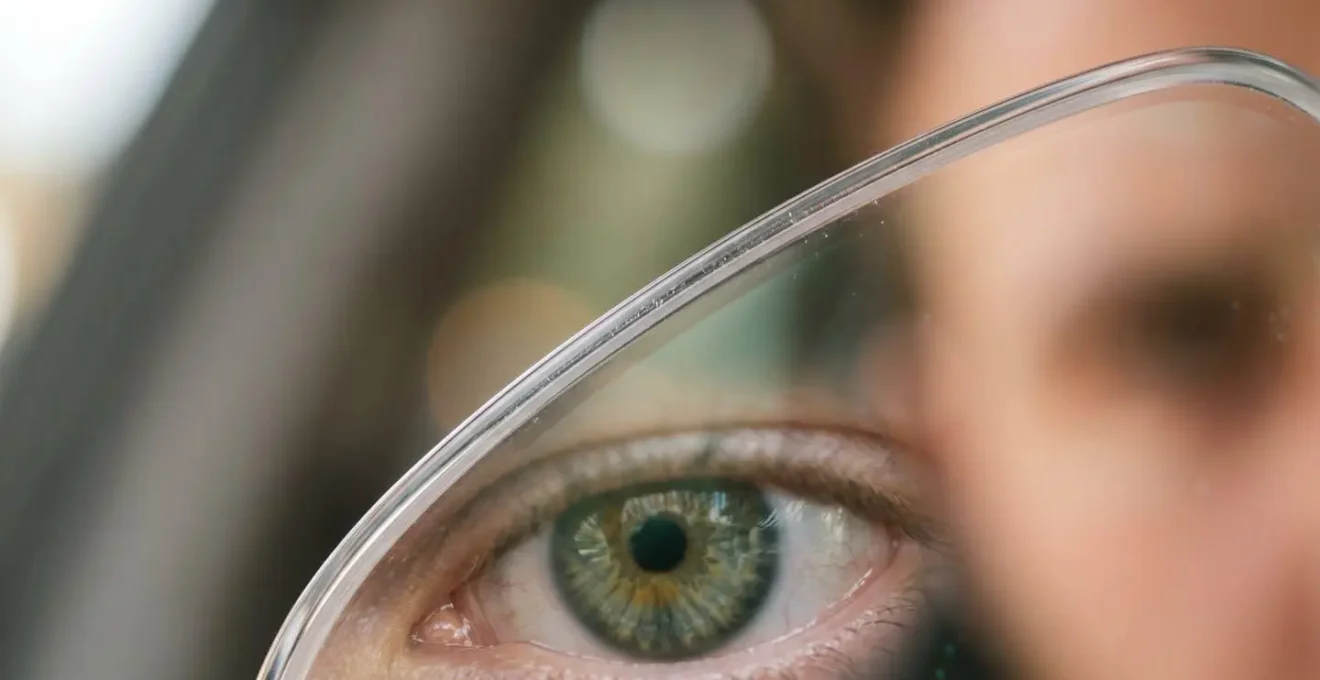
As the image above illustrates, this alignment is a matter of millimeters. For high prescriptions, even a tiny deviation can introduce significant visual discomfort. The following checklist will guide you through a verification process you can do with just a mirror and a marker, empowering you to take an active role in your visual health.
Your Action Plan: Verifying Optical Center Alignment at Home
- Positioning: Stand about 8 inches from a mirror in a well-lit room. Keep your head straight and level, looking directly forward into your own eyes in the reflection.
- Focus: Look straight ahead as if you’re looking through the mirror at a distant object. This ensures your pupils are in their natural “distance vision” position.
- Marking: Using a non-permanent, washable marker (like a dry-erase marker), close your right eye and use your left eye to place a small dot on the left lens directly over the reflection of your pupil’s center. Repeat for the other side: close your left eye and mark the right lens.
- Measurement: Carefully take off your glasses and use a millimeter ruler to measure the distance between the two dots you made. This measurement is the effective optical center distance of your glasses.
- Comparison: Compare this measurement to the Pupillary Distance (PD) listed on your prescription or order. If the difference is more than 2mm, it indicates a potential misalignment that is significant enough to warrant a professional re-check by your optician.
Aspheric or Spherical: Which Lens Design Reduces the “Fishbowl” Effect?
Beyond measurements, the very technology of your lenses plays a huge role in peripheral distortion. Traditionally, lenses were made with a spherical design, meaning the front surface has a uniform curve, like a slice taken from a ball. While effective for correcting vision at the center, this design inherently causes optical aberrations toward the edges, leading to the classic “fishbowl” effect, especially with stronger prescriptions. Objects in your peripheral vision can appear distorted, bowed, or unnaturally magnified.
To combat this, modern optics developed aspheric lenses. Unlike their spherical counterparts, aspheric lenses have a more complex surface profile that gradually changes curvature from the center to the edge. This advanced geometry allows the lens to be made thinner, lighter, and flatter, but its primary visual benefit is the significant reduction in peripheral distortion. According to the Overnight Glasses Optical Research Team in their guide, “Spherical vs. Aspherical Lenses,” aspheric designs are superior for this reason: “The center maintains optimal power correction while the peripheral zones reduce aberrations by up to 60% compared to spherical alternatives.”
For wearers with moderate to high prescriptions (generally above ±2.50 diopters) or those with significant astigmatism, choosing an aspheric lens design can be the single most effective way to eliminate the fishbowl effect and achieve a wider, more natural field of view. However, this precision comes with a caveat: aspheric lenses are less forgiving of fitting errors. An improperly centered aspheric lens can create more visual disturbance than a well-centered spherical one. The table below, based on an analysis from Overnight Glasses, breaks down the key differences.
| Feature | Spherical Lenses | Aspheric Lenses |
|---|---|---|
| Curvature | Uniform curve across entire surface (like a sphere section) | Gradually changing curvature from center to edge (flatter profile) |
| Peripheral Distortion | Higher distortion at edges, fishbowl effect common | Reduces aberrations by up to 60%, eliminates fishbowl effect |
| Best for Prescription | Low prescriptions (under ±2.50 diopters) | Moderate to high prescriptions (over ±2.50 diopters) and significant astigmatism |
| Thickness & Weight | Thicker and bulkier, especially at center (plus lenses) or edges (minus lenses) | Thinner, flatter, lighter profile |
| Fitting Tolerance | More forgiving of slight centering errors | Less forgiving—poorly centered aspheric can create MORE disturbance than spherical |
| Cost | More affordable, simpler manufacturing | More expensive due to advanced CNC machinery and precision requirements |
If you have a strong prescription and are experiencing significant peripheral distortion, discussing a switch to an aspheric lens design with your optician could be the solution. It is a technical choice that directly impacts your daily visual comfort.
The Base Curve Mistake: Why Changing Frame Shape Causes Eye Strain?
Sometimes, the prescription is perfect and the PD is accurate, yet eye strain persists. The culprit can often be found in the shape of your new frames, specifically a parameter known as the Base Curve. The base curve refers to the primary curvature on the front surface of the lens. To fit properly, the base curve of the lens must be compatible with the curvature of the eyeglass frame (the “frame wrap”).
A common scenario for this issue is switching from a relatively flat pair of everyday glasses to a more curved, “wraparound” style frame, like many sunglasses or sport models. When a lens is tilted or wrapped, it effectively changes how the prescription interacts with your eye. This induces what are known as prismatic and power errors, even if the lens itself was ground perfectly to your prescription. Your brain is forced to work harder to compensate for this induced distortion, leading to headaches, eye strain, and a feeling that the vision is just “not right.”
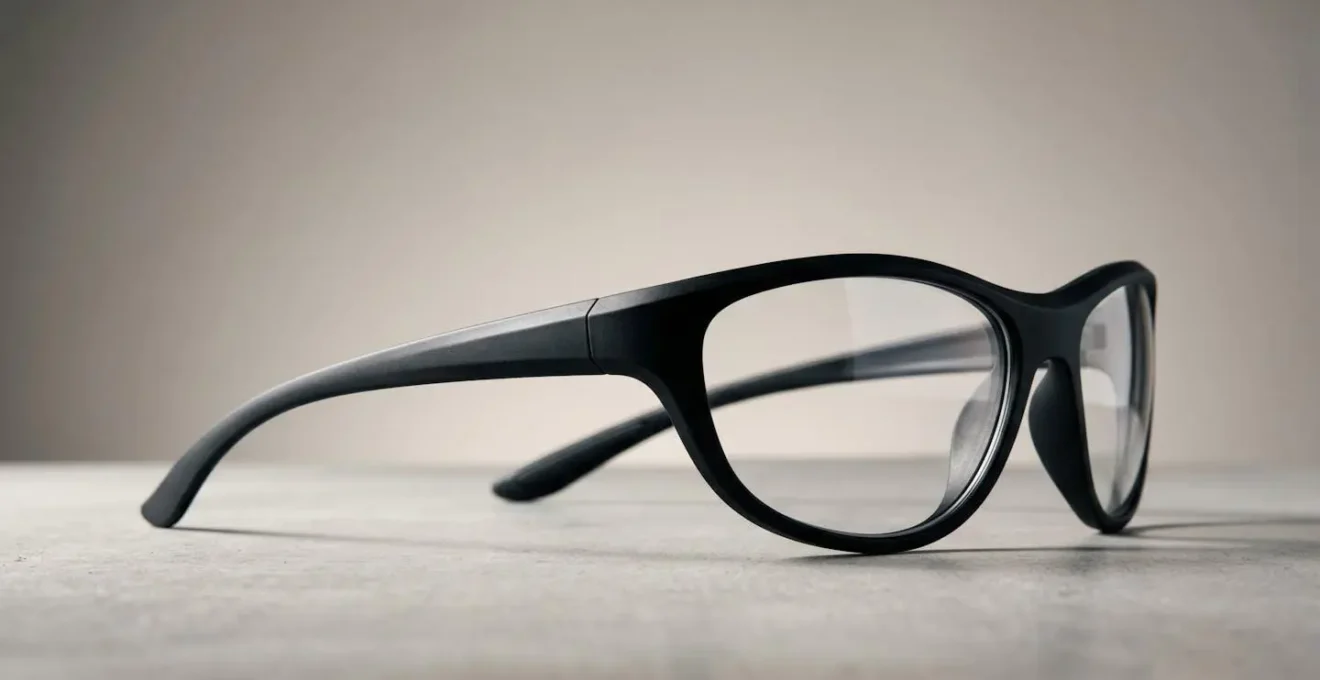
A skilled optician should always account for the base curve. When you change to a frame with a significantly different wrap angle, the laboratory may need to use specially compensated lenses or adjust the prescription to account for the tilt. If you’ve recently switched to a much more curved frame and are experiencing discomfort, a base curve mismatch is a very likely cause. This is a subtle but critical aspect of lens fitting that is often overlooked.
The problem is exacerbated with stronger prescriptions, where even a small change in base curve or tilt can have a dramatic impact on visual comfort. It’s crucial that your optician knows not only your prescription, but also the context of how you’ll be wearing the glasses, including the specific frame you’ve chosen.
When to Go Back to the Optician If Your Headache Won’t Go Away?
The crucial question for anyone experiencing discomfort is: “How long is too long to wait?” While a degree of adaptation is normal, persistent symptoms are a clear signal that something needs to be re-evaluated. The general clinical guideline is that most minor adaptation symptoms should significantly decrease within a few days and resolve almost completely within two weeks. According to optometric guidance, while most people adjust quickly, significant prescription changes or first-time progressive lens wearers might take the full two weeks.
If your symptoms are severe from the start or are not improving after 3-4 days of consistent wear, it’s time to be proactive. You should not have to endure debilitating headaches, vertigo, or double vision. It’s important to distinguish between expected, mild adaptation symptoms and legitimate red flags that require immediate attention. Having a clear framework can help you decide when to monitor your symptoms and when to book a follow-up appointment.
Here is a triage guide to help you assess your symptoms:
- Red Flags (Return Immediately): These symptoms are not normal and require prompt professional attention. They include severe vertigo (a spinning sensation), persistent double vision, headaches that reach a migraine level, or any symptoms that are actively worsening after a few days of wear.
- Yellow Flags (Monitor for 7-14 Days): These are often part of the normal adaptation process but should be watched. They include a mild fishbowl effect in your peripheral vision, slight issues with depth perception (especially on stairs), mild headaches that occur only in the first few days, or a feeling of eye strain as your eye muscles adjust.
- Normal Adaptation Signs: Temporary dizziness with quick head movements, slight distortion at the very edges of your lenses, and brief periods of nausea are all within the realm of normal, especially for those with high-strength prescriptions or new astigmatism correction.
When you do go back, be prepared. Bring both your new and old glasses. Calmly explain how long you’ve worn the new pair and describe your symptoms with as much detail as possible. A helpful script is: “I’ve worn these glasses consistently for [X] days, and I’m still experiencing [specific symptom]. Could we please re-verify the pupillary distance, optical center height, and check that the base curve is appropriate for this frame?” Remember, most opticians offer a 30-90 day adaptation guarantee. If there is a manufacturing or measurement error, you are entitled to a remake.
What Do the Plus and Minus Signs Actually Mean for Your Vision?
To truly understand why new glasses can cause such strange effects, it helps to go back to the fundamental physics of your prescription. The plus (+) and minus (-) signs in the “Sphere” (SPH) value on your prescription are not arbitrary; they describe the physical shape of the lens and how it bends light.
A minus (-) prescription is for nearsightedness (myopia). A minus lens is concave, meaning it is thinner at the center and thicker at the edges. Its job is to spread light rays out before they reach your eye, allowing them to focus correctly on your retina instead of in front of it. This shape inherently has a minifying effect—it makes the world look slightly smaller. This minification is a primary contributor to the “fishbowl” effect, as the perceived change in world size can disrupt your spatial awareness.
A plus (+) prescription is for farsightedness (hyperopia). A plus lens is convex, meaning it is thicker at the center and thinner at the edges. It converges light rays, bringing them forward to focus properly on your retina instead of behind it. This shape causes magnification, which can make objects appear closer and larger than they are. This can interfere with depth perception and hand-eye coordination during the initial adjustment period.
Minus lenses are concave (thinner center) to spread light rays for nearsightedness, while plus lenses are convex (thicker center) to converge light rays for farsightedness. This physical shape is the origin of the optical distortions.
– Dr. Sophia Moh, OD, Adjusting to New Glasses – Zenni Optical
The magnitude of this effect is not linear. A change from -1.00 to -2.00 is far less disruptive than a change from -4.00 to -5.00, even though both are a one-diopter jump. The stronger the prescription, the more pronounced the minification or magnification, and the greater the perceptual shock to your brain, requiring a longer adaptation time. This principle is a key diagnostic factor for optometrists.
Case Study: The Impact of Prescription Magnitude
Optometrists frequently observe that the perceptual adaptation time varies significantly with prescription strength. An analysis of patient adaptation patterns shows a jump from a -4.00 to a -5.00 diopter prescription often requires 2-3 weeks for full adaptation due to the pronounced minification effect making the world seem smaller and more curved. In contrast, a change from -1.00 to -2.00 typically only requires a few days. The stronger the prescription, the more sensitive the wearer’s brain is to these optical effects, magnifying the challenge of the adaptation period.
Key Takeaways
- The “fishbowl” effect and dizziness are often normal symptoms of visual-vestibular conflict as your brain adapts, especially with significant prescription changes.
- Persistent headaches and eye strain are frequently caused by correctable measurement errors, with an incorrect Pupillary Distance (PD) or Optical Center (OC) height being the primary culprits.
- Advanced lens choices (like aspheric designs) and frame characteristics (like base curve) are critical factors that directly impact visual comfort and must be discussed with your optician.
Why Does a Wrong PD Cause Headaches With Strong Prescriptions?
Pupillary Distance (PD) is the distance in millimeters between the centers of your pupils. This measurement is absolutely critical because it dictates where the optical center of each lens should be placed. When you look through any part of a lens other than its precise optical center, you induce an unwanted prismatic effect. This means the lens bends light in a way that shifts the image you are seeing. Your eye muscles must then work constantly to realign the image, and this sustained, unnatural effort is a direct cause of eye strain and severe headaches.
The severity of this effect is directly proportional to the power of your lens. As the Endmyopia Research Team notes, “A 1mm error on a -1.00 lens is negligible; that same 1mm error on a -8.00 lens creates significant prismatic power, causing major strain.” This is why a person with a mild prescription might never notice a small PD error, while someone with a strong prescription will find it intolerable. Unfortunately, errors are not uncommon; a Vision Council report revealed that for customers having issues with new eyewear, nearly 35% of those experiencing problems had incorrect PD measurements on their order.
Furthermore, there are two types of PD measurements: single and dual. A single PD is the total distance from pupil to pupil. A dual PD (or monocular PD) measures the distance from the center of your nose bridge to each pupil individually (e.g., 32mm / 33mm). Most faces are not perfectly symmetrical, so a dual PD is far more precise. For high prescriptions, progressive lenses, or individuals with facial asymmetry, insisting on a dual PD measurement is essential for preventing hidden causes of strain.
| Measurement Type | What It Measures | Best For | Accuracy Level |
|---|---|---|---|
| Single (Binocular) PD | Total distance pupil-to-pupil (e.g., 63mm) | Simple single-vision lenses, symmetrical faces, low-to-moderate prescriptions | Adequate for most standard prescriptions |
| Dual (Monocular) PD | Individual distance from nose bridge center to each pupil (e.g., 32mm / 33mm) | High prescriptions, progressive lenses, asymmetrical facial features, astigmatism | Superior precision—critical for complex prescriptions |
| Why Dual Matters | Most faces are not perfectly symmetrical. A dual PD measurement ensures each lens optical center is positioned perfectly for each individual eye, preventing hidden causes of strain that a single averaged PD might create. | ||
If you have a strong prescription and are experiencing persistent headaches with new glasses, a wrongly measured or applied PD is one of the most likely suspects. It is a simple measurement with profound consequences for visual comfort.
How to Read Your NHS Optical Prescription Without Being an Optometrist?
Becoming familiar with your own prescription is the final step in empowering yourself. You don’t need to be an optometrist to spot potential red flags that might predict a difficult adaptation period. By comparing your new prescription to your old one, you can identify the areas of most significant change. In the UK, the standard NHS optical prescription format provides all the data you need for this analysis.
Your prescription contains several key values: SPH (Sphere), CYL (Cylinder), and AXIS. Understanding what a large change in each of these values means can help you anticipate adaptation challenges and communicate more effectively with your optician. Optometric research demonstrates that correcting for astigmatism, in particular, can be a major source of spatial distortion during the adjustment phase, as the cylindrical lenses used can alter depth perception.
Here is a diagnostic guide to help you interpret the changes in your prescription:
- SPH (Sphere) Value Change: This indicates the main power of your lens for nearsightedness (-) or farsightedness (+). Compare the new SPH value to the old one. A jump of more than 1.00 diopter (e.g., from -2.00 to -3.25) is a significant change that will likely require a longer adaptation period of one to two weeks.
- CYL (Cylinder) and Astigmatism: This value corrects for an irregularly shaped cornea (astigmatism). If you have a new or significantly changed CYL value (e.g., going from 0.00 to -1.25, or any change greater than 0.75), your brain needs to adapt to a much sharper, but differently oriented, world. High CYL makes you extremely sensitive to rotational errors in how the lens is fitted in the frame. If the world feels tilted, the AXIS may be off.
- AXIS Shift Detection: The AXIS is the orientation of the CYL correction, measured in degrees from 1 to 180. A major shift in this number (e.g., from 180° to 90°, or any change greater than 15-20 degrees) is a primary reason for difficult adaptation and can cause significant spatial disorientation.
- BVD (Back Vertex Distance): While not always on the consumer copy, this is a critical factor for strong prescriptions (beyond ±4.00). It’s the distance from the back of the lens to your cornea. If your new frames sit much closer or further from your eyes than your old ones, it can effectively change the power of the prescription your retina receives. Mention this change in fit to your optician.
If your symptoms of dizziness or eye strain persist beyond two weeks, bring both your old and new prescriptions to your optician. This allows them to see exactly where the largest changes occurred and helps them troubleshoot whether the issue is one of normal adaptation to a large change or a potential fitting error.
Now that you are equipped with this clinical knowledge, the next logical step is to use it. Don’t simply endure discomfort. Schedule a follow-up with your optician to discuss your specific symptoms and ask them to verify the measurements you’ve learned about today.