Deciding on high-index lenses isn’t just about cost; it’s a strategic trade-off between aesthetics and optical performance.
- Thinner lenses (higher index) often come at the cost of optical clarity, potentially introducing distracting rainbow halos (chromatic aberration).
- Your frame choice can be as effective as a lens upgrade for minimizing thickness and the “tiny eye” look, often at no extra cost.
Recommendation: Allocate your budget based on your prescription strength. For strong prescriptions (above +/-4.00), prioritize investing in high-tech lenses over designer frames for better daily wearability and comfort.
If you have a strong prescription, you know the dilemma well. You’re presented with the standard lens option and then the tempting, yet significantly more expensive, “high-index” upgrade. The promise is alluring: thinner, lighter lenses that won’t give you the dreaded “coke bottle” look. But as you stare at the price difference—often £100 or more—the question looms: is it a necessary investment in your vision and appearance, or just an expensive luxury? Most advice simply states that thinner is better for high prescriptions, a frustratingly vague platitude.
The conversation rarely goes deeper into the compromises involved. What you’re not always told is that the pursuit of thinness involves a direct trade-off with optical purity. This isn’t a simple “good vs. better” choice. It’s a complex decision where factors like your specific prescription, your choice of frame, and even your sensitivity to light distortions play a crucial role. Forget the simple sales pitch; making the right choice requires a budget-conscious, strategic mindset.
This guide acts as your pragmatic optical consultant. We will dismantle the decision-making process by focusing on the value threshold. We’ll explore the science behind lens thinning, expose the hidden “dispersion trap” that can degrade your vision, and provide a clear framework for allocating your budget. The goal isn’t to convince you to buy the most expensive option, but to empower you to choose the smartest one for your wallet and your eyes.
This article provides a complete framework for making an informed decision. Explore the sections below to understand every facet of the choice between standard and high-index lenses.
Contents: A Pragmatic Guide to Lens Investment
- Why Does Index 1.67 Make Your Lenses Thinner Than Standard 1.5?
- How to Minimize the “Tiny Eye” Look in High Minus Prescriptions?
- Polycarbonate or High Index: Which Material Offers Better Clarity?
- The Dispersion Trap: Why Thinner Lenses Might Cause Rainbow Halos?
- When to Use a Plastic Frame to Hide Lens Thickness Naturally?
- Why Do Some Designer Frames Cost £300 While Others Break in Months?
- Add Power: How to Calculate Your Reading Prescription from Distance Values?
- Designer Frames or High-Tech Lenses: Where Should You Spend Your Budget?
Why Does Index 1.67 Make Your Lenses Thinner Than Standard 1.5?
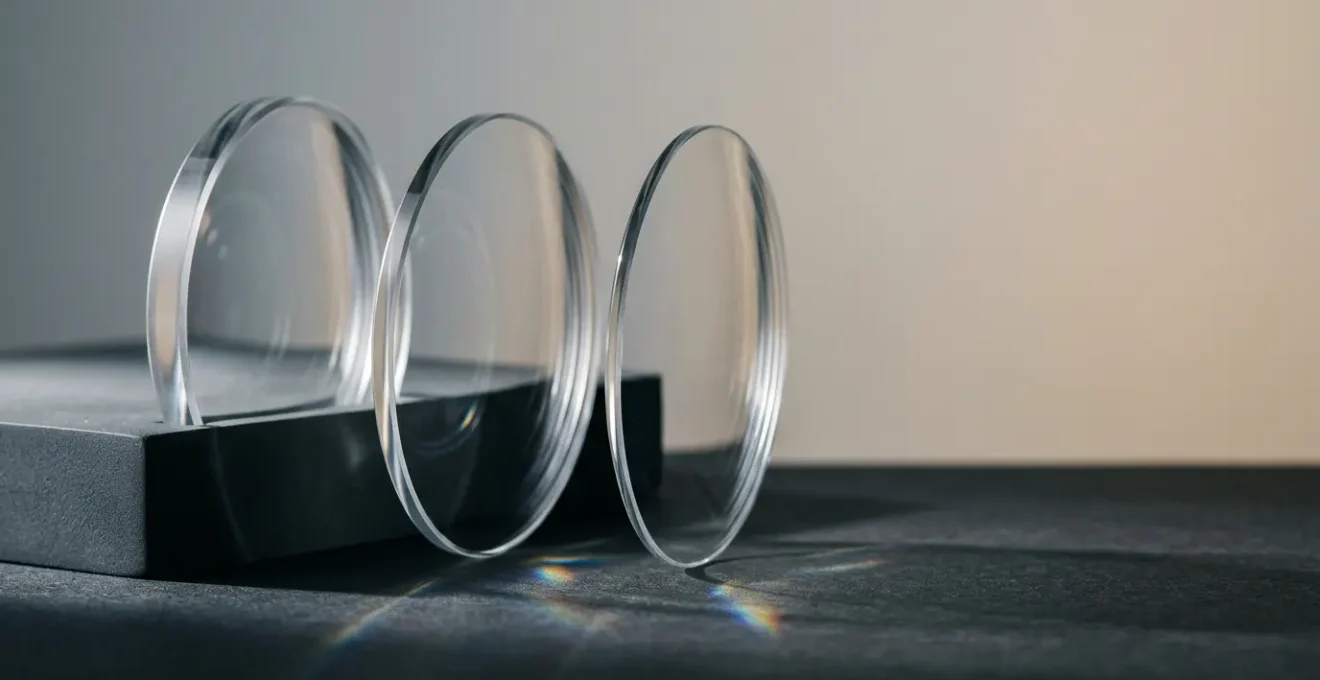
The magic behind thinner lenses lies in a property called the “refractive index.” Think of it as the material’s light-bending power. A standard plastic lens, with a refractive index of 1.50, needs a certain amount of curvature and thickness to correctly bend light and focus it on your retina. Materials with a higher refractive index, like 1.67 or 1.74, are more efficient at bending light. This increased efficiency means they can achieve the same corrective power with less material, resulting in a flatter, thinner, and lighter lens.
The difference is not trivial, especially for high prescriptions. For instance, optical data shows that 1.67 high-index lenses can be up to 30% thinner than standard 1.50 plastic lenses for the same prescription. This reduction is even more dramatic at the highest end of the scale. When you move to the most advanced materials, research from optometry organizations confirms a lens with an index of 1.74 could be up to 50% thinner than a regular 1.50 plastic lens. This significant reduction in bulk is what you’re paying for with the upgrade.
However, this efficiency comes with trade-offs. The very properties that make these materials bend light more effectively can also introduce other optical imperfections. Understanding this core principle is the first step to making a savvy investment rather than just chasing the thinnest possible profile.
How to Minimize the “Tiny Eye” Look in High Minus Prescriptions?
For those with strong minus (myopia) prescriptions, one of the biggest aesthetic concerns is minification, the dreaded “tiny eye” effect. This happens because strong concave lenses, used to correct nearsightedness, make objects viewed through them—including your eyes—appear smaller. While high-index lenses help by being flatter, your choice of frame is an equally, if not more, powerful tool to combat this distortion. Before spending extra on lens thinning, you should first optimize your frame selection.
A smaller, rounder frame is your best ally. Large, rectangular frames require a much larger lens blank, forcing the optician to use the thicker, more distorting outer edges of the lens. By choosing a frame where your pupil is well-centered and the overall shape is closer to a circle, you allow for the thinnest part of the lens to be used, which dramatically reduces both edge thickness and the minification effect. A smart frame choice can provide a visual improvement equivalent to a full step up in lens index, at no extra cost.
Furthermore, the material and style of the frame rim play a crucial role. A thin metal frame will expose every millimeter of lens edge, whereas a thicker acetate (plastic) frame can cleverly hide a significant portion of it. This isn’t just about aesthetics; for the thinnest 1.74 index lenses, which are more brittle, a full-rimmed frame is often required for structural support.
Frame Selection Checklist to Reduce Lens Bulk
- Choose Smaller Frame Sizes: A 6mm reduction in the lens’s effective diameter can reduce edge thickness as much as upgrading one full index step.
- Prioritize Rounder Shapes: Opt for round or oval shapes over wide rectangles to avoid using the thickest outer portions of the lens blank.
- Center Your Pupil: Ensure your pupil is as close to the geometric center of the lens opening as possible to minimize distortion.
- Select Full-Rim Frames: Use the frame itself to hide edge thickness, especially with bolder acetate styles. This is also a structural requirement for ultra-high-index lenses.
- Check Bridge Fit: A well-fitting bridge ensures the glasses sit correctly, keeping your pupils centered and optimizing the optical performance.
Polycarbonate or High Index: Which Material Offers Better Clarity?
When discussing lens materials, “clarity” is not just a marketing term; it’s a measurable scientific property. The key metric is the Abbe value. A higher Abbe value (closer to 60) means the material disperses light less, resulting in sharper vision with fewer distracting color fringes, especially in your peripheral vision. A lower Abbe value (closer to 30) indicates higher dispersion and a greater likelihood of chromatic aberration—the “rainbow halos” we’ll discuss next. This creates a fundamental trade-off: materials with a higher refractive index (thinner lenses) almost always have a lower Abbe value.

This is where the choice between materials like Polycarbonate and High-Index becomes a strategic one. Polycarbonate (index 1.59) is known for its incredible impact resistance, making it the standard for safety and children’s glasses. However, it has a very low Abbe value of 30, putting it at the bottom for optical clarity. A standard 1.60 high-index lens, while only slightly thinner, offers a much better Abbe value of around 40-42, providing a noticeable improvement in visual quality for many wearers. As you climb the index ladder to 1.67 and 1.74 to get thinner lenses, the Abbe value drops again into the low 30s, reintroducing the clarity compromise.
The following table, based on common industry data, breaks down this crucial relationship. It’s the core of the “optical trade-off” and essential for deciding where your priorities lie: ultimate thinness or superior visual clarity. For many people with moderate prescriptions, a 1.60 or 1.61 index lens offers the best of both worlds. As you can see from a recent comparative analysis, the choice is not always straightforward.
| Lens Material | Refractive Index | Abbe Value | Optical Clarity Rating | Best Use Case |
|---|---|---|---|---|
| CR-39 Standard Plastic | 1.50 | 58 | Excellent | Low prescriptions, priority on clarity |
| Trivex | 1.53 | 43-45 | Very Good | Moderate prescriptions, balance of clarity and impact resistance |
| Polycarbonate | 1.59 | 30 | Good | Safety, children, sports (priority: durability over clarity) |
| High-Index 1.60 | 1.60 | 40-42 | Good to Very Good | Sweet spot for moderate to strong prescriptions |
| High-Index 1.67 | 1.67 | 32 | Fair to Good | Strong prescriptions requiring significant thinning |
| High-Index 1.74 | 1.74 | 33 | Fair | Very strong prescriptions (+/-8.00 and above) |
The Dispersion Trap: Why Thinner Lenses Might Cause Rainbow Halos?
The single biggest, yet least discussed, downside of many high-index lenses is chromatic aberration. This is the technical term for the color fringing or “rainbow halos” that can appear around bright lights or high-contrast objects, particularly in your peripheral vision. It’s a direct result of light dispersion, a phenomenon measured by the Abbe value we just discussed. As a leading source in optical science explains, the link is direct and unavoidable.
Materials with a higher Abbe number have lower dispersion, leading to less chromatic aberration. In contrast, materials with a lower Abbe number exhibit higher dispersion and a greater likelihood of chromatic aberration.
– National Center for Biotechnology Information, StatPearls – Chromatic Aberration
This is what I call the “dispersion trap.” In the quest for the thinnest possible lens, consumers are often pushed towards materials like 1.67 or polycarbonate, which have low Abbe values (32 and 30, respectively). While cosmetically appealing, these lenses can degrade the quality of vision for sensitive individuals. You might notice it while night driving, where headlights seem to have colored edges, or when reading black text on a white screen, where the letters might not seem perfectly crisp at the periphery.
Not everyone perceives chromatic aberration, and some people adapt to it. However, if you are particularly sensitive to visual disturbances or spend a lot of time in high-contrast environments, opting for a material with a higher Abbe value (like Trivex at 43-45 or even standard CR-39 at 58) might be a much smarter choice, even if it means a slightly thicker lens. The issue is more pronounced for those with stronger prescriptions and larger frames.
Case Study: Real-World Perception of Chromatic Aberration
Clinical observations from optical practices indicate that individuals with prescriptions above +/-4.00 diopters are the most likely to perceive chromatic aberration when using low Abbe value materials. The phenomenon is most apparent under high-contrast conditions such as night driving, where headlights and street signs against dark backgrounds make color fringing significantly more obvious. Large frames exacerbate the issue by forcing eyes to use more of the lens periphery where aberrations are always more pronounced compared to the optically pure center.
When to Use a Plastic Frame to Hide Lens Thickness Naturally?
One of the most effective and budget-friendly strategies for managing lens thickness has nothing to do with high-tech materials and everything to do with a smart frame choice. A thick acetate (plastic) frame is a powerful tool for visual concealment. While a thin metal rim exposes the entire edge of the lens for all to see, a bolder plastic frame can swallow up several millimeters of thickness, making even a standard-index lens appear sleek and trim.
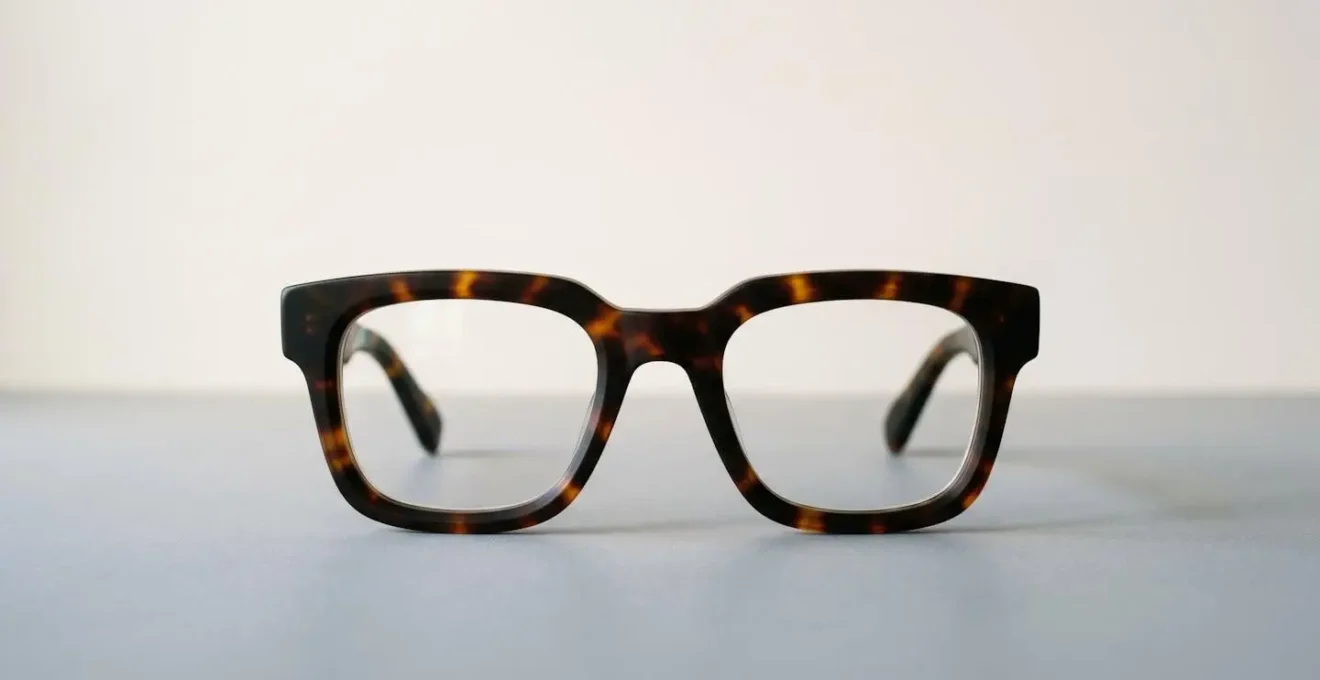
This approach works best for individuals with moderate to strong minus prescriptions, where the edge of the lens is thickest. By choosing a dark, opaque acetate frame, the beveled, polished edge of the lens blends seamlessly into the frame material itself. The key is to look for frames with substantial rim thickness when viewed from the side. This creates a “channel” that effectively hides the lens profile. This technique allows you to potentially opt for a more optically pure, lower-index lens (like 1.60 or even Trivex) without the aesthetic penalty, giving you better vision for less money.
Think of it as optical camouflage. You’re using the frame’s design to solve an aesthetic problem, freeing up your budget to be spent on what matters most: visual quality. For a high-myope, a well-chosen, thick-rimmed frame combined with a mid-index lens can often look better—and provide superior vision—than an ultra-high-index lens in a minimalist metal frame.
Why Do Some Designer Frames Cost £300 While Others Break in Months?
The vast price difference in frames, from £20 online bargains to £300+ designer models, isn’t just about the brand name stamped on the temple arm. True quality in a frame is defined by materials, construction, and finishing, all of which have a direct impact on durability and comfort. A premium frame is an investment in longevity. High-quality materials like Italian acetate or Japanese titanium hold their shape better, resist corrosion from skin oils, and maintain their color and finish over years of wear.
Construction is another key differentiator. Look closely at the hinges. A cheap, flimsy hinge is often the first point of failure. Premium frames often use robust, multi-barrel hinges (like German 5-barrel hinges) that are integrated securely into the frame material. They provide a smooth, solid action that feels reliable. In contrast, low-cost frames may use weak, single-barrel hinges that are simply staked in, leading to wobbliness and eventual breakage.
Finishing is the final, often overlooked, sign of quality. A well-made frame will have its edges hand-polished, resulting in a smooth, comfortable feel. Mass-produced frames often have sharp mold lines or rough edges, especially around the nose pads and temple tips, which can cause irritation. While a designer logo adds to the cost, these underlying indicators of quality are what you are truly paying for. A £300 frame that lasts five years is a better value than a £50 frame you have to replace every year.
Your 5-Point Frame Quality Checklist
- Inspect the Temple Arms: Check for a metal core wire inside the plastic arms. This reinforcement adds significant durability and allows for better adjustments.
- Test the Hinge Action: Open and close the temples. The movement should be smooth and solid with no wiggle. Quality hinges signify superior construction.
- Examine the Edges: Look for hand-polished, rounded edges instead of sharp mold lines. This level of finishing separates premium from mass-produced frames.
- Assess the Nose Pads: Verify if the nose pads are replaceable (a sign of quality) versus being simple integrated plastic, which offers no adjustability.
- Check the Country of Origin: While not a guarantee, frames made in Italy, Japan, and Germany are typically hallmarks of superior optical manufacturing quality.
Add Power: How to Calculate Your Reading Prescription from Distance Values?
As we age, typically starting around our early 40s, the natural lens inside our eye begins to lose its flexibility. This condition, known as presbyopia, makes it harder to focus on near objects. This is where “Add Power” comes in. The “Add” value is an additional magnifying power incorporated into the bottom portion of your lenses (in bifocals or varifocals) to help with reading and other close-up tasks. It is always a positive number (e.g., +1.00, +2.50) and is added to your distance prescription to create your reading prescription.
You cannot calculate your Add power yourself; it must be determined by an optometrist during an eye exam. The value is based on your age and the specific working distance you need. A general guideline is that the Add power starts around +0.75 to +1.00 for someone in their early 40s and progresses to around +2.50 to +3.00 by their 60s. Your optometrist will measure the lowest power that allows you to read comfortably at your preferred distance.
Here’s how it works in practice: If your distance prescription for one eye is -4.00 SPH and your optometrist determines you need an Add of +2.00, your effective reading prescription for that eye is -2.00 (-4.00 + 2.00 = -2.00). This is why if you are myopic, you might find you can read more easily by simply taking your glasses off—doing so effectively adds positive power. Understanding the Add value is crucial for anyone considering varifocal lenses, as it dictates the strength and design of the reading portion of the lens. Clinical ophthalmology standards confirm that high-index lenses provide benefits for patients with high prescription powers, which applies to both distance and complex varifocal designs.
Key Takeaways
- The primary trade-off in lens choice is aesthetics (thinness) versus optical clarity (Abbe value).
- Smart frame selection (smaller, rounder, thicker rims) can be as effective as a lens upgrade for minimizing thickness.
- For prescriptions above +/-4.00 diopters, prioritizing budget on high-quality lenses over expensive frames yields better daily comfort and vision.
Designer Frames or High-Tech Lenses: Where Should You Spend Your Budget?
This is the ultimate question for any savvy glasses wearer. With a finite budget, where does your money make the most impact? The answer depends entirely on the strength of your prescription. For those with a low prescription, the functional difference between a standard 1.50 index lens and a 1.60 high-index lens is minimal. The lens will be relatively thin and light regardless. In this scenario, your money is arguably better spent on a high-quality, durable, and comfortable frame that you’ll love wearing every day. The frame provides the comfort and style, while the standard lens provides excellent optical clarity.
However, as your prescription strength increases, the balance of power shifts dramatically. For someone with a -6.00 prescription, a standard 1.50 index lens will be noticeably thick and heavy, causing visual distortions and discomfort. In this case, investing in 1.67 or 1.74 high-index lenses is no longer a luxury; it’s a critical investment in wearability and quality of life. The reduction in weight and thickness directly translates to all-day comfort. As technical guides from manufacturers like ZENOTTIC show, moving from a standard to an ultra-thin lens for strong prescriptions can reduce lens edge thickness by up to 50% for high-myopia patients. At this level, the frame simply becomes a functional holder for the high-tech optics that are doing all the heavy lifting.
The following framework provides a pragmatic guide to allocating your budget. It’s designed to help you invest your money where it will yield the greatest return in terms of comfort, aesthetics, and visual performance.
| Prescription Range | Recommended Lens Index | Budget Allocation (Lenses vs Frames) | Rationale |
|---|---|---|---|
| Low (+/-0.25 to +/-2.00) | 1.50 Standard or 1.53 Trivex | 30% Lenses / 70% Frames | Minimal thickness difference allows focus on frame aesthetics and comfort |
| Moderate (+/-2.25 to +/-4.00) | 1.60 or 1.61 High-Index | 50% Lenses / 50% Frames | Balance point where lens upgrade provides noticeable comfort and aesthetic improvement |
| Strong (+/-4.25 to +/-6.00) | 1.67 High-Index | 65% Lenses / 35% Frames | Lens quality significantly impacts daily comfort and visual performance |
| Very Strong (+/-6.00 and above) | 1.74 Ultra-High-Index | 70-75% Lenses / 25-30% Frames | Frame becomes functional holder for high-tech optics; lens investment is critical for wearability |
Armed with this knowledge of optical trade-offs and budget allocation, you are now equipped to have an informed conversation with your optician and make a decision that is right for your vision, your style, and your wallet.