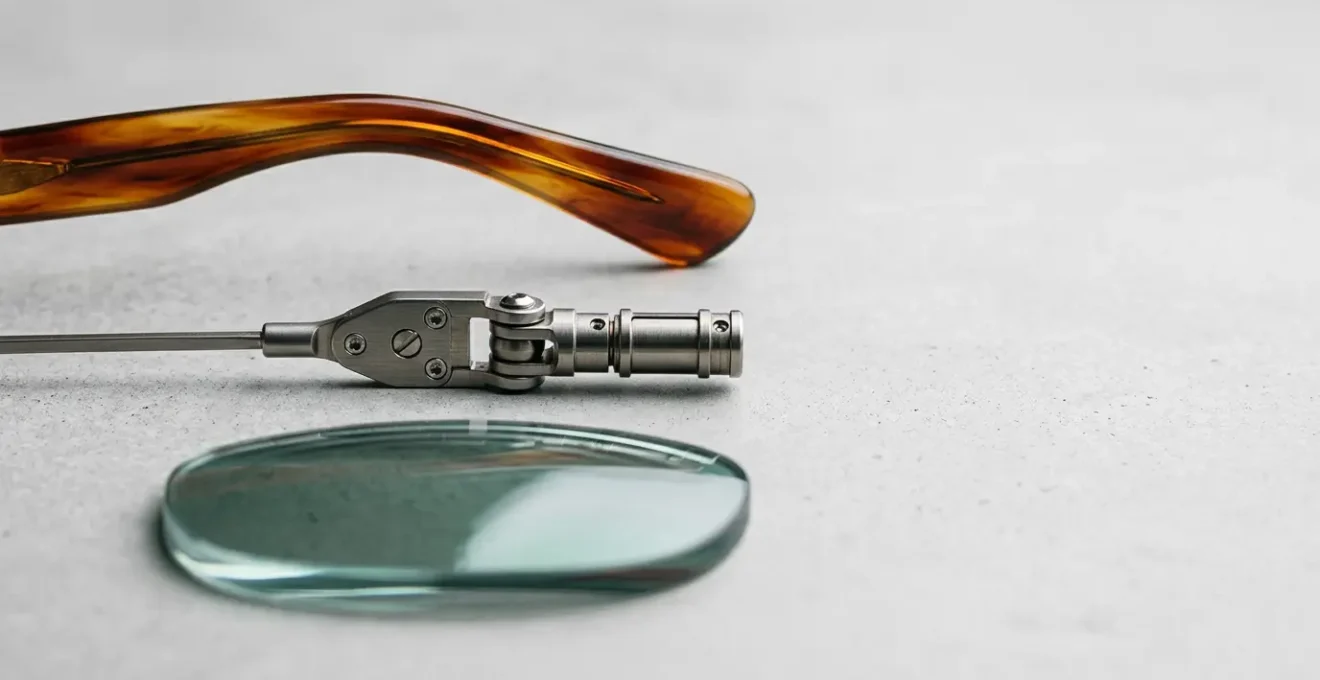
The true value of premium eyewear lies not in choosing between a brand name and lens technology, but in mastering their strategic integration.
- Designer price tags are driven by licensing and retail margins more than materials, but quality craftsmanship is still a factor.
- Advanced lenses offer superior vision, but the thinnest option isn’t always the best due to optical trade-offs.
Recommendation: Prioritise a bespoke, in-person fitting on the High Street. It is the only way to correctly unify frame architecture and optical engineering for unparalleled comfort and performance.
As a London-based executive, your image is a vital asset, curated from your tailored suit down to your choice of watch. Yet, when it comes to eyewear, many sharp professionals face a frustrating dilemma: invest in a statement designer frame that elevates your look, or allocate the budget to high-technology lenses for superior visual clarity? The conventional wisdom offers a split path, forcing a compromise between aesthetics and function. You’re told to either chase a logo or prioritise technical specifications, often leaving you feeling that you’ve overpaid for one at the expense of the other.
This debate, however, misses the point entirely. It frames the choice as a binary trade-off when it should be viewed as the creation of a single, high-performance tool. The most effective eyewear isn’t about a costly frame holding average lenses, nor is it about incredible lenses in a poorly fitting, generic frame. The secret lies in understanding the interplay between the two—what I call the synthesis of frame architecture and optical engineering. It’s about making an intelligent, holistic investment in an object you rely on every single day.
But what if the key wasn’t about where you spend the most money, but *how* you spend it to make these two elements work in perfect harmony? This guide moves beyond the simplistic “frame versus lens” argument. We will deconstruct the true cost of designer frames, explore the science of lens materials, and reveal why the ultimate factor in achieving both style and comfort is something online retailers simply cannot offer. This is your strategic manual for commissioning eyewear that performs as well as it looks.
To navigate this complex decision, we will explore each critical component in detail. The following sections break down everything from material science to the nuances of a perfect fit, providing a clear roadmap for your next eyewear investment.
Summary: Frames vs Lenses: A Strategist’s Guide to Investing in Your Eyewear
- Why Do Some Designer Frames Cost £300 While Others Break in Months?
- How to Choose a Frame That Hides Thick Lenses for High Prescriptions?
- Acetate or Titanium: Which Material Survives Daily Office Wear Best?
- The “Standard Fit” Mistake That Causes Slipping on Narrow Noses
- When to Buy Sunglasses to Get the Best Designer Deals on the High Street?
- Why Do Your Glasses Leave Red Marks and How to Fix It?
- Why Does Index 1.67 Make Your Lenses Thinner Than Standard 1.5?
- Online Glasses vs High Street Fitting: The Comfort Gap You Can’t Ignore?
Why Do Some Designer Frames Cost £300 While Others Break in Months?
The vast price difference in eyewear is one of the most confusing aspects for consumers. One might assume a £300 frame from a luxury fashion house is intrinsically better than a £50 one, but the reality is more nuanced. The price you pay is often less about the raw materials and more about a complex chain of licensing, marketing, and retail mark-ups. In fact, some industry analysis reveals that major chains can apply mark-ups of up to 1,000% from the factory cost.
This doesn’t mean all expensive frames are a rip-off. A significant portion of the cost of a high-end frame from a brand like Tom Ford or Chanel goes towards licensing fees paid to the fashion house. However, true quality differences do exist in the frame architecture. Premium frames often use higher-grade materials like Mazzucchelli acetate, which retains its shape and lustrous finish far longer than standard plastic. They also feature superior hardware, such as five or seven-barrel hinges that resist loosening, and are often hand-polished in workshops in Italy or Japan, resulting in a level of finish and comfort that mass-produced frames cannot match.
Conversely, a cheap frame might look the part initially but often uses inferior plastic that becomes brittle, basic hinges that fail, and finishes that peel or discolour. The key for a discerning buyer is to learn to distinguish genuine craftsmanship from a simple brand premium. The following table breaks down where your money typically goes when purchasing designer eyewear.
| Cost Component | Percentage of Retail Price | Description |
|---|---|---|
| Materials & Manufacturing | 10-20% | Premium acetate, titanium, hand-finishing in Italy/Japan |
| Licensing Fees | 6-15% | Designer brand royalties for use of name and design collaboration |
| Marketing & Distribution | 20-30% | High-profile campaigns, celebrity endorsements, flagship stores |
| Retailer Margin | 40-60% | Optician overhead, retail space costs, professional fitting services |
Understanding this breakdown empowers you to assess value beyond the logo. A high price can signify superior engineering and materials, or it can simply reflect the cost of a brand’s marketing machine.
How to Choose a Frame That Hides Thick Lenses for High Prescriptions?
For those with a strong prescription, often defined by optical professionals as being ±5.00 diopters or stronger, the aesthetic challenge of thick lenses is a primary concern. The dreaded “bottle-end” effect can detract from even the most stylish frame. However, this is where intelligent frame selection—or ‘frame architecture’—becomes a powerful tool to complement your optical engineering. The right frame can dramatically minimise the perceived thickness of your lenses.
The fundamental principle is to reduce the lens’s overall diameter. Smaller, more rounded frames are ideal. A round or panto shape allows the optical centre of the lens to align more closely with the geometric centre of the frame, which means the thickest part of the lens (the edge in a minus prescription) is more likely to be trimmed away during glazing. Conversely, wide, rectangular frames require a much larger lens blank, leaving more of the thick periphery visible.
The material and construction of the frame also play a vital role. Thicker, full-rim acetate frames are your best ally. The substance of the material itself provides a physical shield, concealing the bevelled edge of the lens. Darker or matte-finish colours, such as tortoiseshell or classic black, create an optical illusion that draws attention to the frame and away from the lens edge. In contrast, thin metal or rimless frames offer no such camouflage and will expose the lens profile entirely.
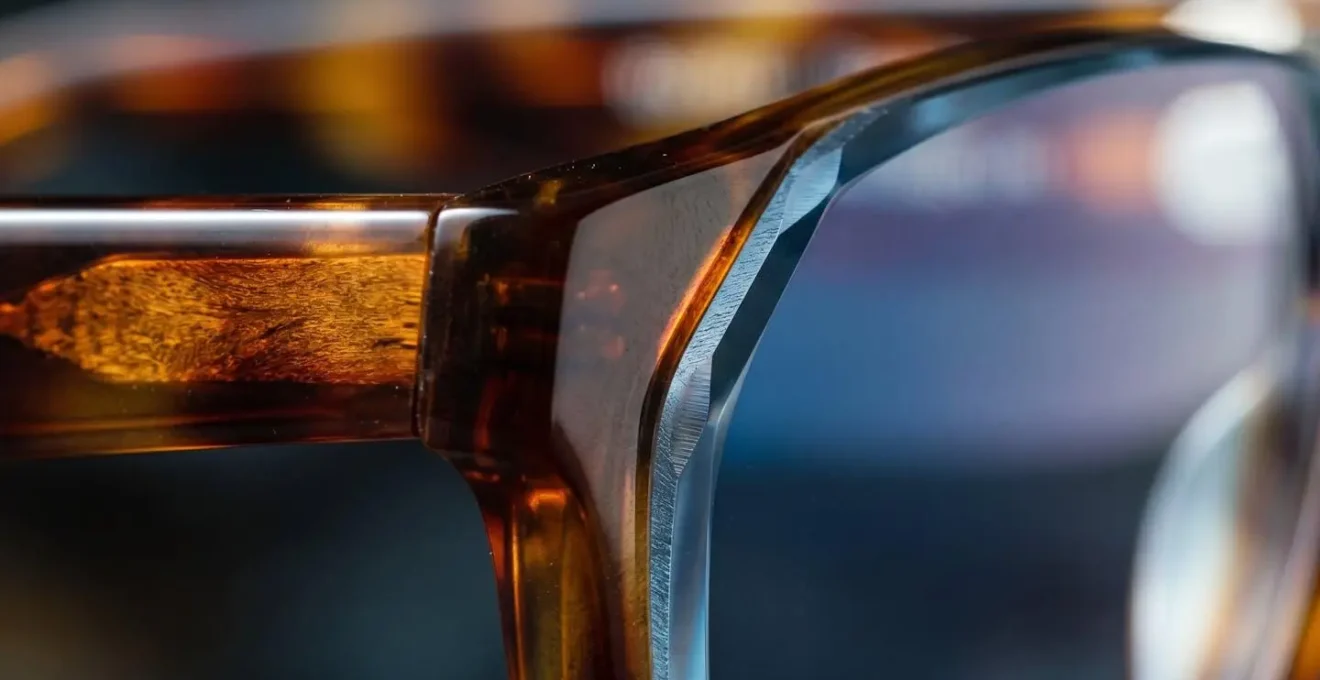
As you can see, the geometry is key. By selecting a frame with a deep vertical height (B-measurement) and a compact lens width, you create the perfect housing to conceal a high-powered lens. An expert optician will guide you toward a frame that not only suits your face but is also engineered to accommodate your specific prescription, ensuring your visual signature is sophisticated, not clinical.
Acetate or Titanium: Which Material Survives Daily Office Wear Best?
When considering the longevity of your investment, the material of the frame is a critical decision. For the modern professional, the choice often comes down to two titans of the industry: classic acetate and high-tech titanium. Each has a distinct profile in terms of durability, comfort, and long-term value, making the decision less about which is “better” and more about which aligns with your lifestyle and priorities.
Acetate, a plant-based plastic, is prized for its rich colour possibilities and warm, substantial feel. High-quality acetate is strong, flexible, and hypoallergenic. Its key advantage in a professional context is its repairability; minor scratches and scuffs from daily wear can often be polished out by an optician, restoring the frame’s lustre. It also holds its shape well, though it can be susceptible to warping if left in extreme heat, such as a car on a summer’s day. It is the traditional choice for a bold, intellectual, or creative visual signature.
Titanium, on the other hand, is the material of performance and minimalism. Its primary benefit is its incredible strength-to-weight ratio; material testing demonstrates that titanium frames are significantly lighter, reducing pressure on the nose and ears during long workdays. It’s also corrosion-resistant and hypoallergenic. Many titanium frames feature ‘memory metal’ properties, meaning they can flex under stress (like being sat on) and return to their original shape. This makes them exceptionally durable. The downside is that they are harder to repair if they do break, and the colour palette is generally more subdued and industrial.
Ultimately, the “Total Cost of Ownership” calculation differs. Titanium offers supreme durability and is an excellent choice if you plan to keep the same frame for many years, simply updating the lenses. Acetate offers stylistic versatility and repairability, making it ideal for those who see their eyewear as a more dynamic part of their wardrobe. Your choice depends on whether you view your frames as a durable chassis or a renewable style statement.
The “Standard Fit” Mistake That Causes Slipping on Narrow Noses
You’ve invested in a beautiful pair of glasses, but you spend your day distractedly pushing them back up your nose. This common frustration is rarely a fault of the frame itself, but rather a failure of the fit—specifically, the “one-size-fits-all” approach to the bridge. Many off-the-shelf frames are built for a generic, ‘standard’ nose bridge, which simply doesn’t work for everyone. For those with a narrower or lower bridge, this results in a lack of grip, causing the frames to slide down constantly.
This is where the science of comfort dynamics comes into play, and it highlights a critical service that only a skilled optician can provide. The fit of a frame is a complex balance of weight distribution across three key points: the two sides of your nose bridge and the tops of your ears. If the bridge is too wide, it fails to make proper contact, transferring the entire weight of the glasses onto your ears and causing the front to slip. As eyewear professionals at West Broward Eye Care note, this is a crucial, non-negotiable aspect of fit.
Bridge fit is most critical – frames should not slide down or leave marks. The bridge size (14mm-19mm range) cannot be adjusted on plastic frames, so exact measurement is essential.
– West Broward Eye Care, Eyewear Style Guide: Frame Selection Fundamentals
A professional fitting addresses this with meticulous adjustments that are impossible to replicate online. An optician can select a frame with the perfect bridge width or choose a metal frame with adjustable nose pads that can be perfectly contoured to your anatomy. They also perform adjustments to the temple arms and pantoscopic tilt, ensuring the frame is perfectly counter-balanced. Designs labelled “Alternative Fit” or “Asian Fit” are specifically engineered with a narrower bridge and adjusted angles for this very reason. A proper fit doesn’t just prevent slipping; it ensures your lenses are positioned correctly for optimal vision and keeps you focused on your work, not on your eyewear.
Your Action Plan: Achieving the Perfect Fit
- Request a pantoscopic tilt adjustment (an 8-12 degree forward angle) to improve lens-to-eye alignment and distribute weight correctly.
- Ask your optician to adjust the temple curvature behind your ears to create the proper counterweight and lifting force off the nose bridge.
- Have the nose pad arm angles customised on a metal frame to match your specific bridge width for optimal weight distribution.
- Consider Alternative Fit or Asian Fit frame designs, which feature lower, narrower nose bridges (14-16mm) and modified temple geometry.
- Verify that the total frame width aligns with your face width (the edges should sit between your cheekbones and temples) to prevent balance issues.
When to Buy Sunglasses to Get the Best Designer Deals on the High Street?
While your primary spectacles are a daily necessity, sunglasses offer a chance to embrace a more fashion-forward element of your visual signature. For the savvy executive, timing this purchase strategically can yield significant savings on High Street designer brands. The retail cycle for sunglasses is deeply tied to seasons and fashion trends, creating predictable windows of opportunity for finding premium styles at a reduced price.
The first and most significant opportunity arises at the end of the summer season. From late August through September, retailers are keen to clear out their spring/summer collections to make way for new autumn stock and optical frames. This is when you will find the most substantial discounts on the season’s most popular designer models. While the selection might be slightly more limited, the savings can be upwards of 30-50%, making it the prime time to invest.
The second window is during the post-Christmas and January sales. While the focus is on winter goods, retailers also use this period to offload any lingering stock from the previous year. This is a particularly good time to find more classic, perennial styles that are less trend-dependent. You may not find the avant-garde runway piece from last summer, but you are very likely to find a timeless aviator or Wayfarer-style frame from a top brand at a very attractive price.
Finally, keep an eye out for “Friends & Family” events at major department stores or independent opticians. These short, promotional periods, often happening in late spring or autumn, can offer a blanket discount (typically 20-25%) across all stock, including new-season arrivals that are not yet on sale. By understanding and anticipating these retail rhythms, you can acquire high-quality designer sunglasses without paying the peak-season premium.
Why Do Your Glasses Leave Red Marks and How to Fix It?
Few things are more telling of an ill-fitting frame than the persistent red marks left on the bridge of your nose after a long day. This discomfort is a clear signal that the comfort dynamics of your eyewear are compromised. It’s a common complaint, but one that is entirely fixable with a proper diagnosis. The marks are almost always caused by one of two issues: excessive weight or poorly distributed pressure.
First, consider the total weight of your eyewear. Heavy glass lenses or a dense, oversized acetate frame can exert constant, direct pressure on the sensitive skin of your nose. If the marks are a generalised feeling of pressure and weight, the solution may lie in material choice. Switching to a lighter frame material like titanium or opting for high-index plastic lenses, which are inherently lighter, can provide immediate relief. This is a fundamental consideration in the initial selection of your frame and lenses.
More often, however, the issue is one of uneven pressure distribution. This is a fitting problem, not a material one. If the red marks are two distinct, sharp points, it indicates that the entire weight of your glasses is being concentrated on two small areas. This can be caused by a plastic frame bridge that is too narrow, or by poorly adjusted nose pads on a metal frame. An expert optician can correct this by precisely adjusting the angle and width of the nose pads to spread the load over a wider surface area. They can also adjust the temple arms to ensure more of the frame’s weight is supported by your ears, effectively lifting it off your nose.
To identify the root cause, you can perform a simple diagnostic:
- The Weight Test: When you remove your glasses, is the relief immediate and diffuse? This points to an issue of total frame mass.
- The Pressure Test: Are the marks sharp and localised? This indicates a problem with weight distribution that requires a professional fitting adjustment.
- The Allergy Test: Is the skin not just red, but also itchy or irritated? This could suggest a sensitivity to the frame material (often nickel in cheaper metal frames), requiring a switch to hypoallergenic titanium or acetate.
Why Does Index 1.67 Make Your Lenses Thinner Than Standard 1.5?
When discussing lenses, the term ‘high-index’ is often presented as the ultimate goal, particularly for those with stronger prescriptions. But what does a number like ‘1.67’ actually mean, and how does it result in a thinner lens? The answer lies in the core principles of optical engineering and a property known as the refractive index. In simple terms, the refractive index measures how efficiently a material can bend light.
A standard plastic lens has a refractive index of 1.5. A high-index lens, with an index of 1.67, is made from a denser material that is significantly more efficient at bending light. Because it can bend light more powerfully, it requires less curvature to achieve the same prescriptive power. This means the lens can be made much flatter and therefore thinner, especially at the edges for short-sighted prescriptions. For instance, optical guidelines suggest using index 1.67 for prescriptions up to ±8.00 D to achieve a noticeable reduction in thickness and weight.
However, this is where a critical trade-off comes into play—one that is often overlooked in a rush for the thinnest possible lens. This trade-off is measured by the ‘Abbe value,’ which indicates the optical clarity of the material. A higher Abbe value means less chromatic aberration (colour fringing), resulting in crisper, clearer vision. As the refractive index increases, the Abbe value typically decreases.
| Lens Index | Ideal Prescription Range | Thickness Reduction | Abbe Value (Optical Clarity) | Key Trade-off |
|---|---|---|---|---|
| 1.5 (Standard) | -2.00 to +2.00 | Baseline (thickest) | 58 (excellent clarity) | Heaviest, but best optical performance |
| 1.61 (Mid-Index) | -2.00 to -4.00 | 20% thinner than 1.5 | 42 (good clarity) | Best value sweet spot for moderate prescriptions |
| 1.67 (High-Index) | -4.00 to -8.00 | 40% thinner than 1.5 | 32 (moderate clarity) | Noticeable chromatic aberration, requires AR coating |
| 1.74 (Ultra High-Index) | -8.00 and higher | 50% thinner than 1.5 | 33 (moderate clarity) | Most expensive, colour fringing without premium AR coating |
As the table shows, a standard 1.5 lens offers superb optical clarity (Abbe 58) but is the thickest. A 1.67 lens is significantly thinner but has a much lower Abbe value (32), which can lead to noticeable colour fringing, especially in your peripheral vision. This is why a high-quality anti-reflective (AR) coating is non-negotiable on high-index lenses, as it helps mitigate these optical compromises. The right choice is not always the highest index, but the one that offers the best balance of aesthetics and optical performance for your specific needs.
The Essentials
- The price of designer frames is a complex mix of material quality, craftsmanship, licensing fees, and retail margins.
- Frame selection is an engineering choice; the right shape and material can dramatically minimise the thickness of high-prescription lenses.
- A professional, in-person fitting is non-negotiable for achieving optimal comfort and visual performance, addressing critical measurements that online retailers cannot capture.
Online Glasses vs High Street Fitting: The Comfort Gap You Can’t Ignore?
In an age of digital convenience, the temptation to purchase eyewear online is strong. The prices appear competitive, and the process seems simple. However, for a discerning individual for whom performance and comfort are paramount, this convenience comes at a significant, often hidden, cost. The gap between an online purchase and a professional High Street fitting is not just about service; it’s about a series of crucial, microscopic measurements that determine the success or failure of your eyewear.
An online retailer can ask for your prescription and your pupillary distance (PD), but this is merely the tip of the iceberg. A true bespoke fitting involves capturing a suite of dynamic measurements that can only be taken in person, with you wearing the specific frame you have chosen. These are not trivial details; they are fundamental to the optical engineering of your lenses. Without them, even the most expensive lenses will underperform.
These critical measurements include:
- Pantoscopic Tilt: The precise angle of the frame front relative to your face. It’s essential for progressive lenses and preventing distortion.
- Vertex Distance: The exact distance from the back of the lens to your cornea. An error here can effectively alter the power of a strong prescription.
- Wrap Angle: The curve of the frame around your face, which impacts peripheral vision.
- Segment Height: The exact vertical position for a bifocal or progressive lens, measured while you are looking straight ahead.
This is the unassailable advantage of the High Street optician. They are not just selling you a product; they are providing a professional service to unify the frame architecture with the optical engineering of your lenses. They ensure the final product is not just a stylish accessory, but a perfectly calibrated instrument tailored to your unique anatomy and visual needs. For an executive who relies on crisp vision and all-day comfort, this is an investment, not an expense.
Therefore, the next time you consider your eyewear, reframe the question. It’s not about frames versus lenses. It’s about how you can leverage the expertise of a professional to create a unified system that enhances both your vision and your personal brand. For a truly optimised result, the path always leads to a trusted High Street specialist.