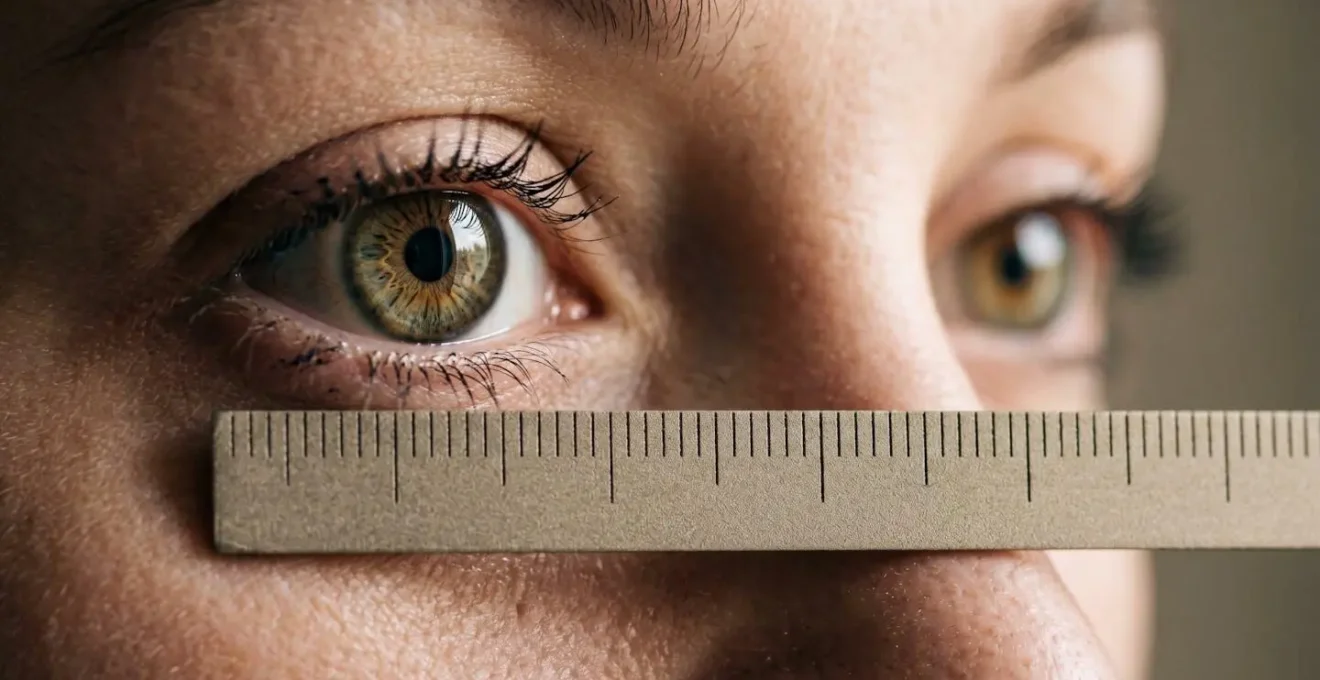
Getting your Pupillary Distance (PD) wrong is the number one reason online glasses orders fail, often resulting in eye strain, headaches, and wasted money.
- A single measurement from an app or ruler is just an estimate, not a confirmation.
- True accuracy comes from cross-verifying your result with at least two other methods to get within a 1mm tolerance.
Recommendation: Use our Measurement Triangulation method to gain the confidence needed to finalize your online purchase without compromising your visual health.
You’ve found the perfect frames online. You’ve entered your prescription. You’re ready to check out, but then you hit a wall: a small, mandatory box labeled “PD”. You might be tempted to guess, use a quick ruler-in-the-mirror trick, or find an “average” number online. But a moment’s hesitation tells you this small number feels disproportionately important. And you’re right. The distance between your pupils is the critical blueprint for crafting your lenses. An error as small as 2mm can be the difference between crystal-clear vision and a pair of glasses that gives you persistent headaches and eye strain.
While many guides offer a single method, this approach ignores the core anxiety of every online glasses buyer: “How do I know if I got it right?” The common advice to “just ask your optician” is valid but unhelpful when you want to complete your purchase now. The real key to unlocking the value of online eyewear isn’t finding one measurement; it’s about building confidence in that measurement through a process of validation. It’s about shifting from guessing to knowing.
This guide acts as your digital optometrist, empowering you to take control. We won’t just show you how to measure your PD; we will explain the science behind why precision is crucial, how to use modern tools correctly, and how to triangulate your results to achieve near-professional accuracy. By understanding the principles, you can order your next pair of glasses with confidence, knowing you’ve secured both significant savings and perfect vision.
To navigate this crucial topic, we will cover the essential steps and concepts that transform a risky guess into a confident measurement. This structured approach will guide you from understanding the risks to mastering the techniques for a successful online purchase.
Summary: Measuring Pupillary Distance at Home: The 2mm Error That Ruins Your Vision?
- Why Does a Wrong PD Cause Headaches With Strong Prescriptions?
- How to Use a PD App Correctly Without a Mirror?
- Dual PD or Single Number: Which Measurement Is Crucial for Progressives?
- The Average PD Myth: Why Guessing “63mm” Is a Gamble?
- When to Ask Your Optician for Your PD During the Exam?
- How to Save £100 a Year by Bulk Buying Lenses Online?
- Why Do Your Glasses Leave Red Marks and How to Fix It?
- Monthly Direct Debits for Contact Lenses: Are High Street Plans a Rip-Off?
Why Does a Wrong PD Cause Headaches With Strong Prescriptions?
Your glasses work by bending light through a specific point in the lens called the optical center. For perfect vision, this point must be directly in front of your pupil. Your Pupillary Distance (PD) dictates exactly where those optical centers are placed. When the PD is wrong, your eyes are forced to look through a different part of the lens. To compensate, your eye muscles must work constantly to fuse the two misaligned images into one clear picture. This creates what’s known as induced prism.
This effect is significantly worse with stronger prescriptions. A high-power lens bends light more aggressively, so even a tiny misalignment creates a much larger prismatic effect. This constant muscular effort is what leads to the classic symptoms of a bad PD: eye strain, fatigue, dizziness, and persistent headaches. Research confirms that even a 1mm PD error can cause noticeable eye strain, especially for those with complex prescriptions. The problem is not just discomfort; it’s that your brand-new glasses are actively working against your eyes.

Think of it like trying to walk while looking through binoculars slightly askew. You can force your brain to make sense of the world, but it will be a nauseating and exhausting experience. A correct PD ensures the lenses are perfectly aligned with your visual axis, allowing your eyes to remain in a relaxed, natural state. Without this alignment, you’re not getting the vision correction you paid for.
How to Use a PD App Correctly Without a Mirror?
PD measurement apps have become remarkably sophisticated, offering a convenient way to get a reading from home. However, their accuracy is entirely dependent on how you use them. Simply pointing your phone at your face and taking a single photo is a recipe for error. To use an app like a professional, you must control the variables to ensure a reliable and repeatable measurement. The goal is to eliminate parallax error (distortions from camera angle) and ensure the app has an accurate scale reference.
Modern technology has made this process surprisingly precise. When used correctly, studies show that PD measurement tools calculate PD with an accuracy comparable to traditional pupillometers, often achieving a margin of error under 1mm. The key is a methodical approach. Do not trust a single reading. Instead, adopt the “Measurement Triangulation” mindset: use the app as your primary tool, but validate its result with at least one or two other simple methods to build confidence. True accuracy is found in the consistency between multiple measurements.
Your Action Plan: The Measurement Triangulation Checklist
- Control the Environment: Use a well-lit area with a simple, uncluttered background. This helps the camera’s software easily detect your pupils without interference.
- Maintain Camera Position: Keep your phone perfectly parallel to your face and at eye level. Do not tilt your head or the phone. This is the single most important step to prevent parallax error.
- Calibrate with a Reference Card: Hold a standard-sized card (like a credit card, with the numbers hidden) flat against your forehead or just below your nose. This gives the app a real-world object to calibrate its scale, drastically improving accuracy.
- Take Multiple Readings: Take at least five separate measurements with the same app. If the results are tightly clustered (e.g., 62.5, 63, 63, 62.5, 63), you have a consistent reading. If they vary widely, your technique needs refinement.
- Triangulate for Confidence: Cross-verify your app’s result with another method. Ask a friend to use a ruler (while you look into the distance) or take a well-lit selfie with a ruler held to your brow to manually calculate. If all methods point to the same number within 1mm, you can be confident in your measurement.
Following this checklist transforms the process from a hopeful guess into a systematic validation. This is how you gain the autonomy to order online without sacrificing the precision your vision deserves.
Dual PD or Single Number: Which Measurement Is Crucial for Progressives?
For many people with simple, single-vision lenses, a single PD number (e.g., 63mm) is sufficient. This number represents the total distance between your pupils and is typically divided by two to center the lenses. However, human faces are rarely perfectly symmetrical. It’s common for one pupil to be slightly farther from the center of the nose than the other. This is where monocular PD, or dual PD, becomes essential. A dual PD is written as two numbers, for example, 31.5/32.5, representing the measurement from the center of your nose to each pupil individually.
While this extra precision is beneficial for everyone, it is absolutely non-negotiable for progressive lens wearers. Progressive lenses have a very narrow vertical “corridor” of clear vision that transitions from distance power at the top to reading power at the bottom. Your pupil must be perfectly aligned with the top of this corridor to see clearly at all distances. If the lens is misplaced by even a millimeter horizontally, your line of sight can fall outside this corridor, rendering the lens ineffective and causing disorientation.
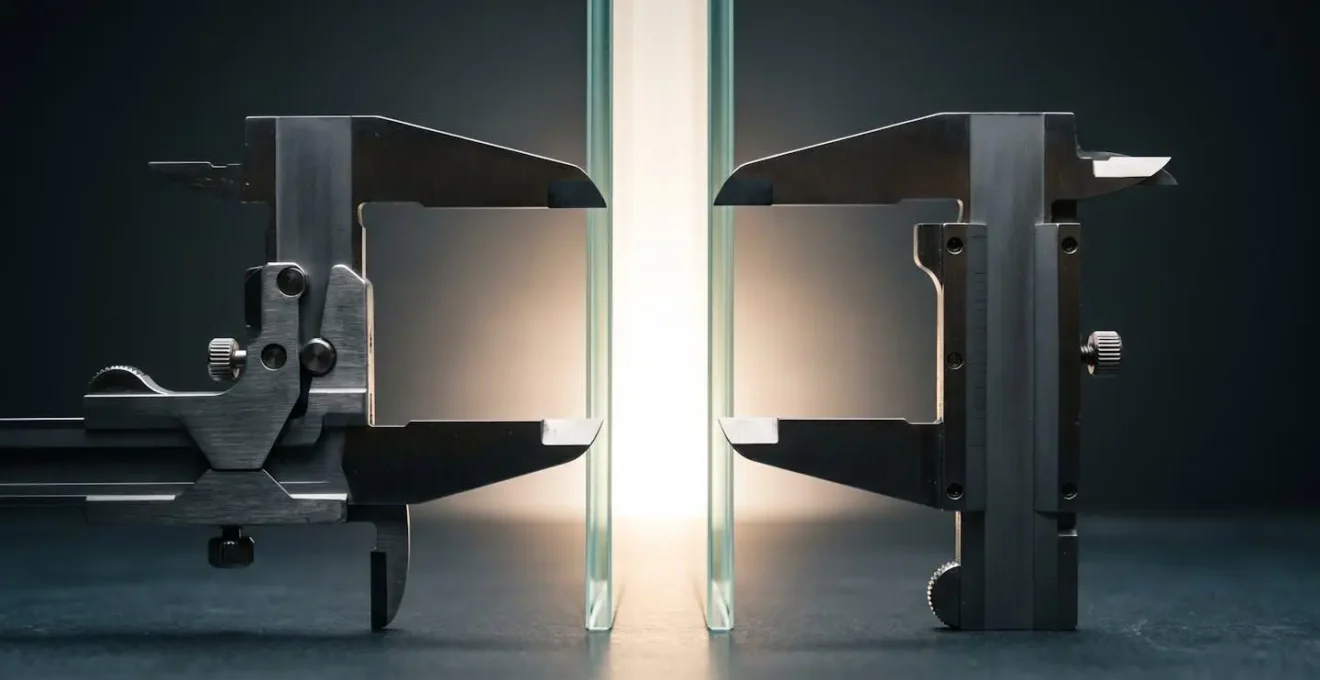
This isn’t just a matter of opinion; it’s a hard limit defined by optical standards. Industry guidelines like ANSI Z80.1 set the fitting tolerance at ±1.0mm per eye for placing the progressive corridor. That single millimeter is the entire margin for error between clear, comfortable vision and a frustratingly unusable pair of glasses. Given that facial asymmetry is the norm, relying on a single, divided PD for progressives is a significant gamble. Always insist on a dual PD measurement for these advanced lenses.
The Average PD Myth: Why Guessing “63mm” Is a Gamble?
In the quest for a quick PD measurement, one of the most tempting and dangerous shortcuts is to use a so-called “average” value, often cited as 63mm for men and 61mm for women. While these numbers may represent a statistical mean, relying on them for your prescription eyewear is like buying “average size” shoes for a marathon. It completely misunderstands the concept of an average and the importance of a personal fit.
An average is just a central point in a wide spectrum of data. A large-scale analysis of real-world measurements reveals just how broad this spectrum is. The data shows that the mean adult PD is around 61.2mm, but the 5th-to-95th percentile spread is 51-71mm. This means that 90% of the adult population falls within a massive 20mm range. Guessing “63mm” when your actual PD could be 58mm or 68mm introduces a huge error that directly leads to the induced prism, eye strain, and headaches we’ve discussed.
Furthermore, this myth completely ignores facial asymmetry and the need for dual PD, especially for higher prescriptions or progressive lenses. Two people can have the same total PD of 64mm, but one might be a symmetrical 32/32 while the other is an asymmetrical 31/33. Using the “average” is not a safe bet; it’s a gamble where the odds are stacked against your visual comfort. Your unique facial anatomy is not average, and your glasses shouldn’t be either. A personal, accurate measurement is the only way to ensure your lenses are made for your eyes.
When to Ask Your Optician for Your PD During the Exam?
The most reliable way to get your pupillary distance is to have it measured by an optician using a pupillometer. This is the gold standard. However, in some regions, providing the PD on the prescription is not standard practice, especially if you don’t purchase glasses from the same location. The key to successfully getting your PD is to be proactive, polite, and clear about your intentions from the outset of your eye exam.
Frame your request as a desire for a complete record for your own use, such as for ordering a backup or specialized pair of glasses (like prescription sunglasses) online. Many opticians are happy to provide this as part of the service. If you encounter resistance, it’s often because the measurement is considered part of the dispensing service, for which there is a cost. Offering to pay a small fee for the measurement service can resolve this, as it respects their professional time and expertise. Remember, you are asking for a crucial piece of your personal health data.
To make the conversation as smooth as possible, you can use a clear and respectful script. Here are the key steps to follow:
- State Your Intent Early: At the start of your exam, say: “In addition to the health check, I’m considering getting a backup pair online. Could you please ensure my pupillary distance is measured and included on my written prescription?”
- Acknowledge Their Expertise: Frame the request as valuing their professional accuracy over other methods. This shows you respect their skills.
- Offer a Dispensing Fee: If there’s hesitation, you can suggest: “I understand the measurement is part of the dispensing service. Would it be possible to pay a small fee, perhaps £10-£20, specifically for that measurement?”
- Request a Dual PD: Be specific. Ask: “Could I please have the monocular (or dual) PD with separate right and left eye measurements? I may need it for progressive lenses.”
- Verify Before You Leave: Check the written prescription card before you depart to confirm the PD value (e.g., PD: 64 or R: 31.5, L: 32.5) is clearly noted.
How to Save £100 a Year by Bulk Buying Lenses Online?
The primary motivation for measuring your own PD is to unlock the significant cost savings of buying glasses online. While the initial effort to get an accurate measurement may seem tedious, the financial payoff is substantial and recurring. Online retailers have lower overheads than traditional high-street opticians, and they pass these savings directly to the consumer. The price difference isn’t trivial; it often represents a saving of nearly 50%.
The financial argument is compelling. For example, a 2025 survey of UK customers shows an average saving of £103 per pair when buying online compared to in-store. This is the direct reward for taking control of your PD measurement. However, this saving is only realized if the glasses are usable. An inaccurate PD turns a £100 purchase into a £100 loss, forcing you to buy a replacement pair and wiping out any potential savings. Therefore, the 10 minutes you invest in accurately measuring and validating your PD is the most valuable step in the entire online purchasing process. It secures your savings and guarantees the usability of your purchase.
The following table illustrates the true cost-benefit analysis, factoring in the risk of an incorrect PD measurement. It clearly shows that investing time in an accurate measurement is the most financially sound strategy.
| Purchase Scenario | Cost Breakdown | Risk Factor | Effective Total Cost |
|---|---|---|---|
| High Street Purchase | £250 for frames + lenses with professional fitting | Very Low (professional PD measurement & fitting) | £250 guaranteed usable |
| Online Purchase (Poor PD Measurement) | £100 for frames + lenses | High (50% risk glasses unusable due to wrong PD) | £100 + potential £100 replacement = £200 risk |
| Online Purchase (Accurate PD Measurement) | £100 for frames + lenses + 10 min proper PD measurement | Very Low (accurate PD via triangulation method) | £100 secured savings of £150 |
Why Do Your Glasses Leave Red Marks and How to Fix It?
While we’ve focused on the optical importance of PD, it’s also intrinsically linked to the physical comfort and fit of your frames. If your glasses constantly leave red marks on your nose or behind your ears, it’s not just a comfort issue—it’s a sign that the frame is unstable. This instability directly compromises the precise positioning of the lenses that your accurate PD measurement was meant to ensure. A frame that slides down your nose or sits crooked is constantly moving the optical centers away from your pupils.
Therefore, a good fit is the physical foundation that upholds your optical alignment. The red marks are symptoms of a poor fit that needs to be diagnosed and corrected. If the frame bridge is too narrow, it will pinch your nose and sit too high. If it’s too wide, the glasses will slide down, misaligning the lenses. Similarly, temple arms that are too tight or too short will pull the frame askew. When buying online, choosing a frame with adjustable features is a smart strategy to buffer against minor fit issues and secure your optical alignment.
Here is a quick guide to diagnosing and fixing the common causes of red marks, ensuring your frame provides a stable platform for your lenses:
- Red marks on the nose bridge: This usually means the frame’s bridge is too narrow or the nose pads need to be adjusted wider. This instability can cause the lenses to shift, magnifying any small PD errors.
- Red marks behind the ears: This indicates the temple arms are too short or are curved too tightly. An ill-fitting arm fails to hold the lenses in the correct, stable position relative to your pupils.
- Choose frames with adjustable nose pads: When ordering online, frames with adjustable silicone nose pads give you the ability to fine-tune the fit, providing a crucial tolerance buffer and helping to perfect the lens position.
- Check frame material for comfort: Lightweight materials like titanium or TR90 reduce the overall pressure on your nose and ears, which helps maintain a consistent and stable alignment all day.
- Verify temple length: Ensure the arm length is appropriate for your head. This keeps the glasses from sliding, which is essential for keeping the optical centers aligned with your pupils.
Key Takeaways
- An incorrect PD causes “induced prism,” forcing your eye muscles to work overtime and leading to headaches, especially with strong prescriptions.
- A single PD measurement is a guess. True confidence comes from “Measurement Triangulation”—cross-verifying an app result with other methods.
- For progressive lenses, a monocular (dual) PD is non-negotiable to align with the lens’s narrow vision corridor.
Monthly Direct Debits for Contact Lenses: Are High Street Plans a Rip-Off?
The ability to measure your PD at home empowers you to “unbundle” the process of buying glasses—getting a health check from one professional and purchasing the product from another online provider. This naturally leads to the question: can the same be done for contact lenses? The answer here is a firm no, and understanding why clarifies the boundary between user autonomy and necessary professional care.
As experts from the Kits.com Optical Education Team note, the requirements for fitting contact lenses go far beyond a simple PD measurement.
Unlike glasses, contact lens fitting requires measurements (like Base Curve and Diameter) that are impossible to do at home and are critical for eye health.
– Kits.com Optical Education Team, Kits.com Contact Lens Prescription Guide
A contact lens sits directly on the cornea, a delicate and living part of your eye. An improper fit can restrict oxygen flow, leading to serious health complications. This is why a professional fitting, which assesses the unique curvature and size of your eye, is a medical necessity, not an optional service. High street direct debit plans, while sometimes more expensive than buying lenses in bulk online, bundle this essential, ongoing professional oversight with the product. They are not a “rip-off” but a different service model for a different type of medical device.
The “Unbundling” of Eyecare Services
The traditional high street model bundles multiple services—the eye exam, professional fitting, the product, and convenience—into a single transaction or payment plan. Buying glasses online represents the “unbundling” trend. In this model, customers intelligently separate the components: they receive the essential health check and prescription from an optometrist, perform the PD measurement themselves (or get it from the pro), and then source the manufactured product (frames and lenses) from a competitive online provider. This allows consumers to optimize each part of the value chain: paying for crucial professional services where they are medically necessary (like eye health exams and contact lens fittings) while leveraging the cost advantages of scale for standardized products like glasses.
By mastering your PD measurement for glasses, you are not cutting corners; you are acting as an informed consumer, intelligently unbundling a service to your advantage. The next logical step is to confidently apply this knowledge to your next online purchase, securing both savings and perfect vision.