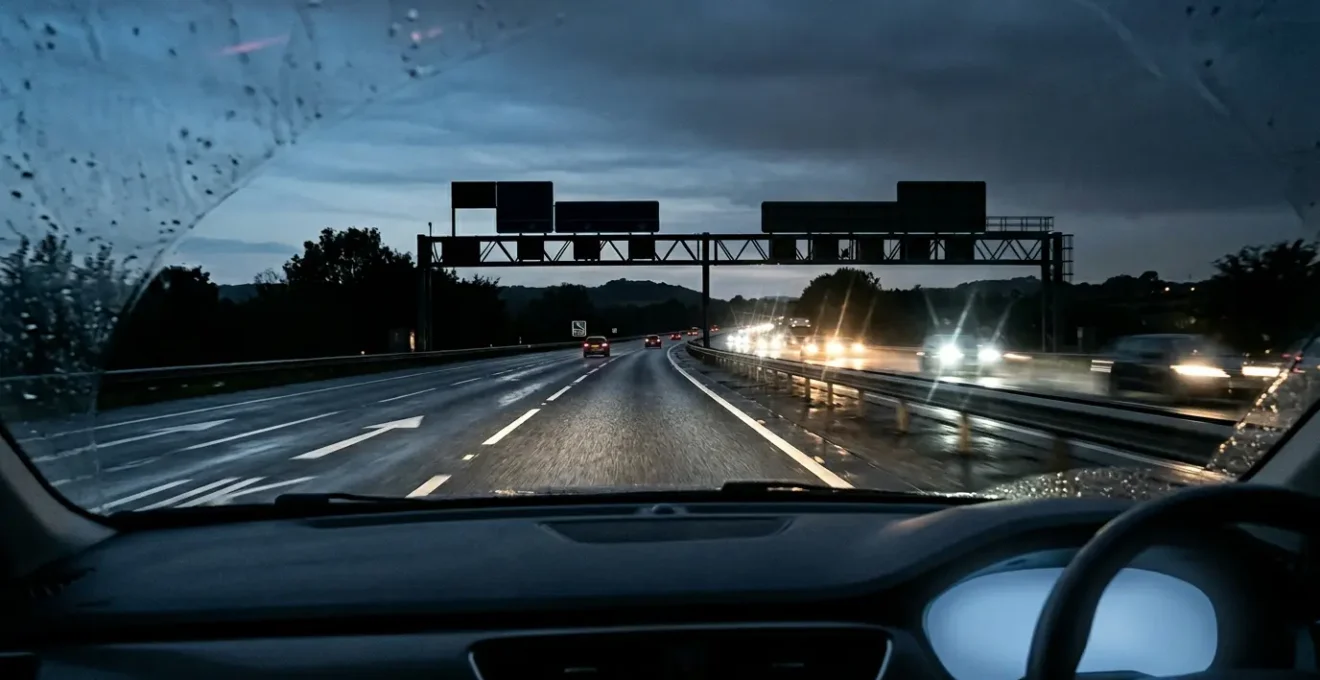
The painful glare from modern headlights isn’t just an annoyance; it’s a solvable physics problem.
- Standard “night driving glasses” with yellow tints are a myth and can actually reduce your vision and are not recommended by UK optometrists.
- The key to safety lies in a premium, multi-layer anti-reflective coating on correctly prescribed lenses, not a specific type of glasses.
Recommendation: Prioritise a comprehensive eye examination and invest in a high-quality lens coating over any off-the-shelf “anti-glare” solution.
If you’ve ever been momentarily blinded by an oncoming vehicle on a dark, wet British road, you understand the visceral fear that modern headlight glare can induce. It’s a near-universal complaint among drivers, a painful, dazzling light that seems to shatter the darkness and leave you struggling to see. Many resort to common fixes like cheap yellow-tinted glasses or simply hope for the best, accepting it as an unavoidable part of modern driving. This frustration is so widespread that research confirms an astonishing 97% of UK drivers report being dazzled by oncoming headlights, making it a critical road safety issue.
But what if the solution wasn’t about finding a magic pair of glasses, but about understanding the science of light itself? As an optical engineer, I can tell you that glare is not random. It is a predictable phenomenon governed by the physics of light, the chemistry of lens coatings, and the biology of your own eyes. The discomfort you feel from LED headlights isn’t in your imagination; it’s a direct result of their specific optical properties. Similarly, the halos you see around streetlights aren’t just a nuisance; they are optical aberrations that can be measured and corrected.
This guide moves beyond the myths. We will dissect the problem from an engineering perspective, exploring why modern headlights are different, how lens technology can (and cannot) help, and what practical, science-backed steps you can take to reclaim your confidence and safety behind the wheel after dark. We will examine the evidence and give you the tools to make informed decisions, not just for your comfort, but for the safety of everyone on the road.
To navigate this complex topic, we will break down the science into manageable parts. This article provides a structured roadmap, from understanding the source of the problem to implementing the most effective solutions, helping you to see clearly and drive safely on UK roads at night.
Summary: An Engineer’s Roadmap to Beating Night-Time Glare
- Why Do Modern LED Headlights Cause More Painful Glare Than Older Bulbs?
- How to Choose Polarized Lenses for Winter Sun Glare?
- Contacts or Glasses: Which Option Reduces Halo Effects at Night?
- The Myth of Yellow Night Driving Glasses: Do They Help or Hinder?
- When to Clean Your Windshield to Instantly Reduce Oncoming Glare?
- Why Does Your Ability to See Pedestrians Drop by 50% at Night?
- Why Does Opening the Oven Door Ruin Your Glasses Coating?
- Poor Night Vision: When Should You Stop Driving After Dark for Safety?
Why Do Modern LED Headlights Cause More Painful Glare Than Older Bulbs?
The intense, almost painful glare from modern headlights is not a figment of your imagination; it’s a direct consequence of a fundamental shift in vehicle lighting technology. The culprits are Light Emitting Diodes (LEDs), which have replaced the softer, warmer halogen bulbs of the past. The difference lies in two key optical properties: brightness (lumens) and colour temperature (Kelvins). As highlighted in UK parliamentary discussions on road safety, this change is significant.
LED vehicle headlights are much bluer and brighter than the halogen headlights of the past. Halogen headlights are usually around 3,000 lumens, but LED lights are commonly double that, with a colour temperature of 6,000 Kelvins, which is much bluer than that of halogen bulbs.
– UK Parliament Hansard debate transcript, Road Safety: Headlight Glare debate, 8 May 2024
This higher colour temperature means the light contains more blue-violet wavelengths. The human eye is particularly sensitive to this part of the spectrum, which can trigger more significant pupil constriction and a greater sensation of dazzling. Furthermore, blue light scatters more easily within the eye’s internal structures (the cornea and lens), which increases the perception of haze and glare. Compounding this is the design of the beam itself. LED headlights create an extremely sharp horizontal cut-off between light and dark, which can feel jarring as vehicles crest hills or navigate uneven UK roads. This intense contrast gives your eyes less time to adapt, contributing to the feeling of being momentarily blinded.
On a wet road, this problem is magnified. The water on the tarmac acts like a mirror, reflecting that intense, blue-shifted light directly into your eyes, creating sheets of reflected glare. It is this combination of sheer intensity, blue-rich colour, and sharp beam patterns that makes modern headlights a significant safety challenge for many drivers.
How to Choose Polarized Lenses for Winter Sun Glare?
While many seek a single solution for all types of glare, the physics of light demands a targeted approach. Polarized lenses are a phenomenal tool for daytime driving, especially during the UK winter when the sun sits low in the sky. They work by filtering out horizontally-oriented light, which is the primary component of glare reflecting off wet roads or the bonnets of other cars. This dramatically increases contrast and reduces eye strain. However, this same mechanism makes them highly dangerous for night driving.
At night, your primary goal is to maximize the amount of light reaching your eyes. Polarized filters, by their very nature, block a significant portion of light. Using them after dusk severely reduces your ability to see into shadows, spot hazards, or identify pedestrians. This critical reduction in luminous transmittance is why optometrists and road safety experts are unequivocal: never wear polarized lenses for driving at night. A “two-pair” strategy is the safest and most effective approach for UK drivers who face both daytime and nighttime challenges.
This involves having one pair of high-quality polarized sunglasses for daytime use and a separate pair of clear, prescription glasses with a premium anti-reflective coating for night driving. It’s essential to ensure any daytime tinted lenses comply with British Standard BS EN ISO 12312-1:2013, which governs luminous transmittance for safe driving. Lenses that are too dark (transmittance below 8%) are illegal for driving at any time in the UK. For driving in twilight, the lenses must let in more than 75% of light.
Contacts or Glasses: Which Option Reduces Halo Effects at Night?
When drivers experience halos, starbursts, or streaks around headlights and streetlights, a common question arises: would contact lenses be better than glasses? The answer, from an optical engineering standpoint, is that the format—contacts or glasses—is less important than the quality of the vision correction itself. Halos are often a symptom of uncorrected or poorly corrected vision, particularly higher-order aberrations like astigmatism.
Astigmatism occurs when the cornea or lens has an irregular, non-spherical shape, causing light to focus on multiple points instead of one. This scattering of light is what creates the distinct halo or starburst effect. Both glasses and contact lenses can correct for astigmatism, but the precision of the correction is paramount. An off-the-shelf solution or an outdated prescription will fail to solve the root problem. As optical experts note, a personalised fit is key.
An off-the-shelf product simply can’t account for your unique vision or correct for conditions like astigmatism, which can make nighttime glare significantly worse.
– iDoctor optometry practice, Clearer Nights: The Best Lenses for Night Driving guide
For some individuals, contact lenses can offer a slight advantage. Because they sit directly on the cornea, they move with the eye, providing a consistently wider field of corrected vision and eliminating the potential for reflections from the back surface of a spectacle lens. However, if a contact lens is not fitted correctly, is dry, or rotates on the eye (a common issue with toric lenses for astigmatism), it can actually worsen aberrations. Conversely, a well-made pair of glasses with a premium anti-reflective coating on a modern, freeform lens design can provide exceptionally clear vision. The crucial first step is a comprehensive eye examination to get a precise and up-to-date prescription.
Ultimately, the best option is the one that provides the most accurate and stable correction for your specific visual needs. A conversation with your optometrist about your night driving experiences will allow them to recommend the optimal solution, whether it’s precision-fitted contact lenses or state-of-the-art spectacle lenses.
The Myth of Yellow Night Driving Glasses: Do They Help or Hinder?
One of the most persistent myths in motoring is the belief that yellow-tinted glasses improve night vision. Marketed as “HD” or “night driving glasses,” these products claim to reduce glare and enhance contrast. The scientific and clinical evidence, however, tells a very different and more dangerous story. From an optical perspective, placing any coloured filter in front of your eyes at night reduces the total amount of light reaching your retina. This is a simple matter of physics.
While the yellow tint can create a subjective feeling of the world being “brighter” and may filter some blue light, this is a perceptual trick. In reality, by diminishing the overall light transmission, they make it harder to see hazards in poorly lit areas. This is a critical safety trade-off. The UK’s leading professional body for optometrists is unequivocal in its public safety advice.
Yellow-coloured filters are not proven to help and may even be dangerous, as the tint makes dark parts of the road appear even darker.
– Daniel Hardiman-McCartney MBE FCOptom, Clinical Adviser, The College of Optometrists public safety statement, October 2023
The core problem with night driving is a lack of light, not the wrong colour of light. Any device that further reduces the amount of light entering the eye is counter-productive and potentially hazardous. It can reduce your ability to spot a pedestrian in dark clothing or a cyclist without lights. The only proven, safe, and effective way to manage glare at night with eyewear is to use clear, correctly prescribed lenses with a high-quality, multi-layer anti-reflective (AR) coating. This coating works by maximising light transmission (up to 99.5%) and minimising reflections from the front and back surfaces of the lenses, thereby reducing the ghost images and halos that contribute to glare.
In short, yellow lenses are not a solution; they are part of the problem. They provide a false sense of security while actively degrading your ability to see in low-light conditions. For genuine safety, stick to the science: clear lenses with an excellent AR coating.
When to Clean Your Windshield to Instantly Reduce Oncoming Glare?
One of the most effective and immediate ways to reduce headlight glare has nothing to do with expensive glasses—it’s about maintaining a pristine windscreen. A dirty, greasy, or hazy windscreen is a primary cause of light scatter. Instead of passing straight through the glass, oncoming light hits microscopic particles of dirt, dust, and oil, and is scattered in all directions. This is what transforms a sharp point of light into a blinding starburst effect.
The problem is often worse on the *inside* of the glass. Over time, a film builds up from plastic off-gassing from the dashboard, road salt spray circulated by the heating system, and residue from breath. This nearly invisible layer is a perfect surface for scattering light. A seasonal cleaning schedule is essential for UK drivers:
- Winter (November-March): Clean the interior windscreen at least weekly. The combination of heater use and damp conditions accelerates film buildup. The low winter sun angle also makes any haze or smearing far more noticeable and debilitating.
- Spring/Summer (April-October): Increase cleaning frequency to remove pollen, dust, and insect residue from the exterior. These create light-scattering hotspots that are especially problematic at dusk and dawn.
Proper cleaning technique is also critical. Use a dedicated automotive glass cleaner (not household products, which can contain ammonia that damages plastics) and two microfiber cloths. Use the first cloth with the cleaner to apply in circular motions, then use the second, clean and dry cloth in vertical and then horizontal strokes to remove all residue for a streak-free finish. This same principle applies to your spectacle lenses, which should be cleaned daily, and your vehicle’s headlight covers, which can scatter your own beam when dirty, reducing your visibility and causing glare for others.
Why Does Your Ability to See Pedestrians Drop by 50% at Night?
The fight against night-time glare is not just about driver comfort; it is a life-or-death issue for vulnerable road users. At night, your visual system is already compromised. Your pupils are dilated, your depth perception is reduced, and your ability to perceive colour and contrast is significantly lower. When you add the blinding effect of headlight glare, your ability to detect a low-contrast object—like a pedestrian in dark clothing—plummets dramatically. Research shows that pedestrians are three to seven times more vulnerable in the dark than in daylight. The statistics for the UK paint a grim picture of this increased risk.
According to the Department for Transport’s 2024 pedestrian factsheet, an average of 7 pedestrians died and 104 were seriously injured per week in reported UK road collisions. A significant portion of these incidents occurs during hours of darkness. The reason for this drastic drop in visibility is twofold. First, the human eye’s photoreceptors (rods), which are responsible for night vision, are excellent at detecting motion but poor at discerning detail and colour. This makes it inherently harder to identify a stationary or slow-moving person.
Second, headlight glare introduces a phenomenon called disability glare. This is not just a feeling of discomfort; it is a measurable reduction in visual performance. The stray light scattered across your retina creates a veil of luminance, effectively washing out the contrast between an object and its background. A pedestrian that was faintly visible against the dark tarmac can completely disappear within this veil of light. This is why managing glare through proper eyewear and a clean windscreen is not a luxury; it’s a fundamental part of a driver’s responsibility to road safety.
Why Does Opening the Oven Door Ruin Your Glasses Coating?
For spectacle wearers, the single most important technology for combating night glare is the anti-reflective (AR) coating. However, not all coatings are created equal. The “free” or basic AR coating often included with high-street glasses is fundamentally different from a premium, multi-layer coating, and its durability is a key factor. One of the biggest enemies of a basic coating is sudden, extreme temperature change, a phenomenon known as thermal shock. A classic example is the blast of heat you get when opening an oven door.
The lens and the thin AR coating are made of different materials that expand and contract at different rates. When exposed to rapid heat, this mismatch in expansion can cause the coating to develop a network of fine cracks, known as “crazing”. This crazed surface is a disaster for night driving, as it dramatically increases light scatter and turns every point of light into a hazy mess. Premium coatings are engineered to resist this. They include a reinforced hard coat layer that provides a more robust and flexible foundation, allowing the lens and coatings to withstand greater temperature fluctuations. But thermal shock isn’t the only danger. Several common UK scenarios can degrade your lenses:
- Hot Cars: Leaving glasses on a dashboard during a UK summer heatwave can expose them to temperatures over 70°C, warping the coating layers.
- Aerosols: Hairspray and deodorants create a chemical film that is difficult to remove and degrades the coating’s performance.
- Abrasive Cleaning: Using kitchen roll, a t-shirt, or even a dry cloth on a dry lens will scratch the AR surface. Always use a dedicated lens spray and microfiber cloth.
The difference in durability and performance between a basic and a premium coating is stark, directly impacting their effectiveness and lifespan. Investing in a premium coating is investing directly in your long-term visual safety.
| Feature | Basic Free Coating (UK High Street) | Premium Multi-Layer Coating |
|---|---|---|
| Number of coating layers | 2-3 layers | 5-7 layers |
| Thermal shock resistance | Low – susceptible to crazing | High – reinforced hard coat layer |
| Scratch resistance | Minimal – no hard coat | Integrated scratch-resistant layer |
| Hydrophobic/Oleophobic | Not included | Top layer repels water and oils |
| Light transmission | ~95-97% | Up to 99.5% |
| Typical UK retail cost | Free with prescription | £30-£80 additional |
| Expected lifespan | 12-18 months | 24-36 months with proper care |
Key Takeaways
- Modern LED headlights are scientifically more likely to cause glare due to their high intensity and blue-shifted colour temperature.
- Yellow-tinted “night driving glasses” are a dangerous myth; the only safe eyewear solution is clear, correctly prescribed lenses with a premium anti-reflective coating.
- Glare is not just an issue with your eyes or glasses; a dirty windscreen is a major contributor to light scatter and must be kept meticulously clean, inside and out.
Poor Night Vision: When Should You Stop Driving After Dark for Safety?
Recognising a decline in your own night vision can be difficult, as it often happens gradually. However, for the safety of yourself and others, it is a responsibility that every driver must take seriously. The fear is real; a survey by The College of Optometrists found that nearly a fifth of UK drivers worry about failing to see a cyclist or pedestrian in the dark. This anxiety is often a good indicator that something has changed with your vision. One of the most significant age-related factors is glare recovery. Research shows that older drivers’ eyes take around 9 seconds to recover from glare, compared to just 1 second for a teenager. Nine seconds of temporary blindness on a motorway is a terrifying prospect.
It can be hard to objectively assess your own capabilities. Making excuses to avoid driving after sunset, or feeling a rising sense of panic when faced with an unfamiliar B-road at night, are significant warning signs. If you experience these, it is not a personal failure but a critical signal to seek professional advice. An optometrist can identify underlying causes such as cataracts (which cause significant light scatter), uncorrected astigmatism, or other conditions. In many cases, an updated prescription and high-quality lenses can make a world of difference.
However, there may come a time when, even with the best possible correction, driving at night is no longer safe. Making that decision is an act of profound responsibility. The following checklist can help you self-assess and decide when it’s time to have an honest conversation with your optometrist and your family.
Your Night Driving Safety Checklist: Warning Signs for UK Drivers
- Do you actively avoid unfamiliar B-roads or rural A-roads at night that you would drive confidently during the day?
- Does oncoming headlight glare leave you feeling temporarily blind for 3+ seconds, struggling to recover your vision?
- Have passengers or family members spotted hazards (pedestrians, cyclists, road signs) before you do when driving at night?
- Do you find it increasingly difficult to judge the speed or distance of oncoming vehicles after dark?
- Have you noticed halos, starbursts, or excessive glare around streetlights or traffic lights that worsen at night?
If you answer “yes” to two or more of these questions, it is imperative that you book an eye examination and specifically discuss your night driving concerns with an optometrist. It may not mean you have to stop driving at night, but it is a clear sign that you need to take action.
Your ability to see clearly at night is a dynamic system involving your eyes, your eyewear, your vehicle, and your awareness. Taking an engineering-led approach—understanding the causes and implementing proven solutions—is the most effective way to ensure your safety. The next logical step is to book a comprehensive eye examination with an optometrist to get a precise, up-to-date assessment of your visual needs.