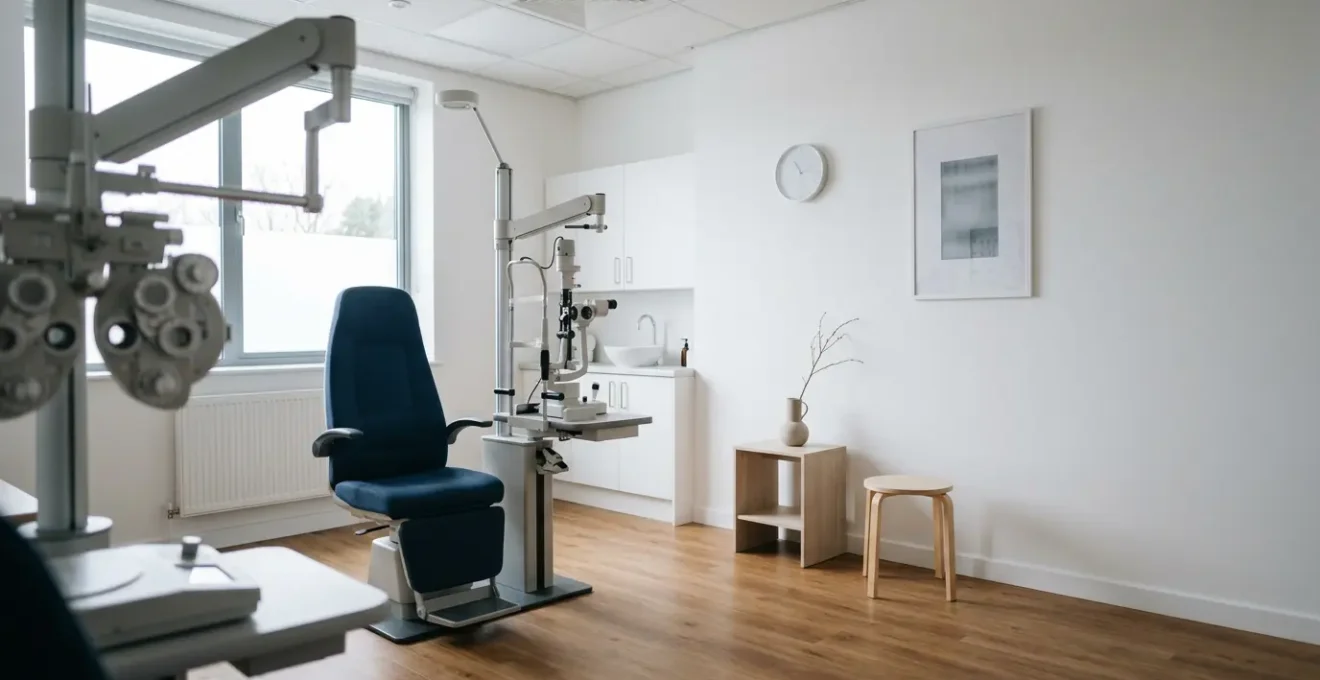
Contrary to popular belief, your NHS eye test’s primary purpose is not just to get a glasses prescription.
- It is a comprehensive health check that screens for serious, asymptomatic conditions like glaucoma and macular degeneration.
- It is often the first place where signs of systemic diseases, such as diabetes and high blood pressure, are detected.
Recommendation: Prioritise this 20-minute appointment every two years as a non-negotiable part of your preventative health routine.
That reminder landing on your doormat or pinging into your inbox is easy to ignore, isn’t it? Life is busy, and scheduling an eye test can feel like another chore to squeeze in. For many, the appointment is synonymous with the slightly tedious process of reading letters from a chart, followed by the potential expense of new glasses. It’s perceived as a simple vision check, a task to be postponed until the words on a page or a road sign become noticeably blurry.
But what if this perspective is fundamentally flawed? What if that 20-minute slot is less about updating your prescription and more about conducting a vital MOT for your health? The truth is that an NHS eye test is one of the most accessible and powerful preventative health screenings available to us in the UK. It’s a crucial window, not just into the health of your eyes, but into the health of your entire body. To postpone it is to do more than risk a year of squinting; it’s to miss an opportunity to protect your precious “vision capital” and catch serious health issues before they become irreversible.
This guide demystifies what truly happens during that appointment. We will explore why this regular check-up is non-negotiable, what the technical jargon on your prescription actually means, and how this brief consultation with an optometrist serves as a critical first line of defence for your long-term well-being. It’s time to reframe the eye test from a reactive purchase to a proactive investment in your health.
To help you navigate this essential topic, this article breaks down the most critical aspects of your eye health journey. The following sections will guide you from understanding the ‘why’ behind routine checks to knowing when a situation requires immediate, urgent attention.
Table of Contents: A Complete Guide to Your NHS Eye Examination
- Why Every Two Years Is the Non-Negotiable Standard for Eye Tests?
- How to Prepare for Your Eye Exam to Get the Most Accurate Prescription?
- NHS vs Private Eye Tests: Which Service Level Do You Really Need?
- The Risk of Relying on Online Vision Checks Instead of Professional Screening
- When to Book an Emergency Eye Test Instead of a Routine Check-Up?
- What Do the Plus and Minus Signs Actually Mean for Your Vision?
- Why Is the Optometrist Your Primary Care Doctor for the Eyes?
- How to Preserve Your Vision Capital After 40 Without Medication?
Why Every Two Years Is the Non-Negotiable Standard for Eye Tests?
The recommendation for an eye test every two years isn’t an arbitrary figure designed to sell more spectacles. It is a carefully considered public health standard based on the typical progression rate of serious, vision-threatening eye conditions. Many of the most damaging diseases, such as glaucoma, diabetic retinopathy, and early-stage macular degeneration, develop slowly and without any noticeable symptoms in their initial phases. By the time you perceive a change in your vision, significant and often irreversible damage may have already occurred.
Think of it as a crucial “health MOT” for your eyes. This regular screening provides a baseline of your ocular health, allowing an optometrist to detect minute, subtle changes that are invisible to you. Within the UK’s public health framework, optometry practices are a cornerstone of preventative care, providing more than 13 million NHS sight tests across England annually. This widespread access is designed specifically to catch conditions early when treatment is most effective.
For example, the “puff of air” test (non-contact tonometry) measures the internal pressure of your eye. A gradual increase in this pressure is a key risk factor for glaucoma, a condition that quietly steals peripheral vision. Without this routine check, you would be completely unaware of the mounting risk. The two-year interval is the sweet spot that balances the likelihood of catching these slow-moving diseases against overburdening the healthcare system. For individuals with known risk factors, such as a family history of glaucoma or a diabetes diagnosis, your optometrist may even recommend annual check-ups.
Ultimately, treating your biennial eye test as a non-negotiable appointment is an act of profound self-care. It’s a proactive measure that moves beyond simple vision correction and enters the realm of long-term health preservation, ensuring your “vision capital” is protected for years to come.
How to Prepare for Your Eye Exam to Get the Most Accurate Prescription?
An eye exam is not a test you can pass or fail, but you can take simple steps to ensure the results are as accurate as possible. The goal is to give your optometrist the clearest possible picture of your daily visual needs and your overall health. Effective preparation hinges on one key element: clear and open communication. Your optometrist is a healthcare partner, and the more information you provide, the better they can serve you.
Before your appointment, take a moment to think about any visual issues you’ve been experiencing. Are you getting headaches after working on the computer? Is night driving becoming more challenging? Do you find yourself holding books further away? Make a mental or physical note of these specific symptoms. It’s also crucial to bring your current glasses or contact lenses with you, even if you don’t wear them often. This allows the optometrist to assess your current prescription as a starting point. Furthermore, have a list of any medications you are taking, as some can have side effects that impact your vision or eye health.

During the consultation, don’t be afraid to ask questions. If you don’t understand a part of the test or a term being used, ask for clarification. This interaction is a dialogue. Describing what you see—or don’t see—honestly is far more important than trying to “guess” the right letter on the chart. Your subjective feedback is a vital piece of the puzzle that, combined with the objective measurements from the equipment, leads to a precise and comfortable prescription. This collaborative approach ensures the final result isn’t just technically correct, but is also perfectly tailored to your lifestyle.
On the day of the test, try to ensure your eyes are not overly fatigued. If you’ve spent eight straight hours staring at a screen, your eyes might be strained, which could temporarily affect the results. If possible, allow for a short break from intense screen use before your appointment. This simple preparation helps provide a more representative snapshot of your vision.
NHS vs Private Eye Tests: Which Service Level Do You Really Need?
A common point of confusion is the distinction between an NHS-funded eye test and a private one. It’s essential to understand that this isn’t a simple case of “basic” versus “premium.” An NHS eye examination is a comprehensive and clinically robust health check designed to identify signs of injury, disease, or abnormality, as well as determine your prescription. It covers all the essential procedures required to safeguard your ocular health, including vision acuity tests, intraocular pressure measurement, and an examination of the back of your eye (the retina).
For the vast majority of the population, the standard NHS eye test is perfectly sufficient for maintaining eye health and detecting common problems. Eligibility for a free NHS test is broad, covering children, students, those over 60, and individuals with specific medical conditions like diabetes or a family history of glaucoma. This public health provision ensures that cost is not a barrier to essential preventative care.
So, what does a private eye test offer? Often, the “private” or “enhanced” option includes the use of more advanced diagnostic technology. The most common of these is the Optical Coherence Tomography (OCT) scan. An OCT scan is like an ultrasound for your eye; it uses light waves to take cross-section pictures of your retina. This technology allows the optometrist to see the distinct layers of the retina in incredible detail, enabling them to detect signs of conditions like macular degeneration, glaucoma, and diabetic retinopathy at a much earlier stage than is possible with traditional methods alone. Some practices may also offer digital retinal photography as part of an enhanced test, providing a permanent photographic record of your retina to track changes over time.
The choice between NHS and private ultimately comes down to your personal health strategy and risk profile. An NHS test provides a full, clinically necessary health screening. An enhanced private test, with additions like an OCT scan, offers an even deeper level of preventative insight. It can be particularly valuable for those with a high-risk profile or for anyone who wants the ultimate peace of mind. Many opticians now offer OCT as an affordable add-on to the standard NHS test, providing a sensible middle ground.
The Risk of Relying on Online Vision Checks Instead of Professional Screening
In our digital age, the temptation to use an online “eye test” or a smartphone app is understandable. They seem quick, convenient, and cheap. However, it is critically important to understand that these tools are not a substitute for a professional eye examination conducted by a qualified optometrist. Relying on them for your eye health is a dangerous gamble, as they provide a false and potentially harmful sense of security.
These digital tools can, at best, only offer a rudimentary estimation of your refractive error—that is, your need for glasses or contact lenses. They completely lack the ability to perform the most crucial function of an eye test: screening for disease. As a consensus of eye care specialists confirms:
Online eye tests do not evaluate the health of your eyes. They only measure your visual acuity and refractive error.
– Multiple optometry experts, Consensus from American Optometric Association and eye care specialists
An optometrist uses specialised equipment to look inside your eye, examining the optic nerve, the macula, the lens, and the retinal blood vessels. This internal examination is the “systemic window” that can reveal the first signs of serious conditions. An online test, performed on a standard screen, cannot physically do this. It’s like asking a website to check your blood pressure—it’s simply not possible.

The risks of skipping a professional screening are significant. You could be allowing a sight-threatening condition to develop unchecked, or missing the early warning signs of a systemic disease like a brain tumour or hypertension. To put this into perspective, consider the following checklist of sight- and life-threatening conditions that a professional optometrist can detect, but an online test simply cannot.
Your Actionable Checklist: Why an In-Person Test Is Irreplaceable
- Glaucoma: Requires intraocular pressure measurement and a direct look at the optic nerve.
- Cataracts: Needs a direct examination of the eye’s lens using a slit lamp.
- Macular Degeneration: Demands retinal imaging and detailed examination of the macula.
- Diabetic Retinopathy: Requires a comprehensive examination of the retinal blood vessels, often after pupil dilation.
- Systemic Health Conditions: Hypertension, diabetes, and even some tumours can be detected by observing changes in the eye’s blood vessels and structures.
When to Book an Emergency Eye Test Instead of a Routine Check-Up?
While routine eye tests are for preventative care and monitoring gradual changes, some symptoms demand immediate attention. Understanding the difference between a minor irritation and a genuine eye emergency can be crucial in preserving your vision. Postponing a routine check-up is unwise, but delaying a visit in an emergency can have devastating and permanent consequences.
You should contact your optometrist immediately or go straight to A&E if you experience any of the following red-flag symptoms:
- Sudden Vision Loss: A sudden and significant decrease in vision in one or both eyes, or a shadow, ‘curtain,’ or ‘veil’ falling across your field of vision.
- Flashes and Floaters: A sudden and dramatic onset of flashing lights, especially if accompanied by a shower of new ‘floaters’ (black dots or squiggles). This can be a sign of retinal detachment.
- Significant Eye Pain: Acute, severe pain in or around the eye, particularly if it’s accompanied by redness, nausea, and blurred vision.
- Eye Injury: Any physical trauma to the eye, whether from a direct blow or a foreign object, requires immediate medical assessment.
- Sudden Double Vision: The abrupt appearance of double vision can indicate a serious neurological or muscular issue.
Conditions like retinal detachment are a time-critical medical emergency. The retina is the light-sensitive tissue at the back of the eye, and if it detaches, it loses its blood supply and stops working. Urgent evaluation and treatment are needed, as vision can be permanently lost if the detachment is not repaired within 24-72 hours. Recognising the warning signs is therefore paramount.
A helpful way to remember the key indicators of a potential retinal detachment is the F.A.S.T. method, adapted for eye emergencies. If you experience these symptoms, especially in combination, time is of the essence. Do not wait to see if it gets better; seek professional help immediately. Your local optometrist is often equipped to handle many eye emergencies and can triage your condition, providing treatment or referring you to a hospital eye service if necessary.
What Do the Plus and Minus Signs Actually Mean for Your Vision?
After your eye test, you’ll be handed a prescription that can look like a secret code of numbers, letters, and symbols. The most fundamental of these are the plus (+) and minus (-) signs in the ‘Sphere’ (SPH) box. These symbols are not arbitrary; they describe the type of refractive error you have and the kind of lens needed to correct it. Understanding them is the first step to demystifying your own vision.
A minus sign (-) indicates myopia, or short-sightedness. If you are myopic, you can see near objects clearly, but distant objects—like a road sign or the TV from across the room—appear blurry. This happens because your eye focuses light in front of the retina, instead of directly on it. A minus-powered lens is ‘concave,’ meaning it’s thinner in the centre and thicker at the edges. This shape helps to diverge light rays before they enter your eye, effectively pushing the focal point back onto the retina so you can see distant objects clearly.
Conversely, a plus sign (+) indicates hyperopia, or long-sightedness. If you are hyperopic, you may see distant objects clearly, but have difficulty focusing on near objects, leading to eye strain or blurry vision when reading or using a computer. This occurs because your eye focuses light behind the retina. A plus-powered lens is ‘convex,’ meaning it’s thicker in the centre and thinner at the edges. This shape converges light rays, bringing the focal point forward onto the retina. It’s a common misconception that long-sighted people have “good” vision; in reality, their eyes are constantly working harder to focus, especially up close, which can lead to significant fatigue and headaches.
The number that follows the sign (e.g., -2.50 or +1.75) represents the ‘power’ of the lens required, measured in units called dioptres. The further the number is from zero, the stronger the prescription and the more correction your vision needs. So, a prescription of -5.00 indicates a higher degree of short-sightedness than -1.00. Grasping this simple plus/minus distinction empowers you to understand the fundamental nature of your eyesight.
Why Is the Optometrist Your Primary Care Doctor for the Eyes?
There is a common misunderstanding of the optometrist’s role. Many people see them simply as technicians who test vision and sell glasses. This perception dangerously undervalues their extensive training and critical function within the UK’s healthcare system. It is more accurate and helpful to think of your optometrist as the primary care doctor for your eyes.
To qualify in the UK, an optometrist must complete a university degree in optometry followed by a year of supervised clinical practice. They are trained healthcare professionals skilled in diagnosing, managing, and treating a wide range of eye conditions. Their expertise goes far beyond simply determining a prescription. They are qualified to detect diseases like glaucoma, cataracts, and macular degeneration. Crucially, they are also trained to recognise the ocular signs of systemic diseases, acting as a vital “systemic window” for your overall health. Conditions such as diabetes, high blood pressure, high cholesterol, and even certain types of brain tumours can manifest with subtle changes in the blood vessels and nerves at the back of the eye.
In many cases, an optometrist is the first healthcare professional to detect these serious underlying health issues, prompting a life-saving referral to a GP or specialist. They are an integral and accessible part of the primary care network. Unlike GPs, who may have long waiting lists, high-street opticians offer readily available appointments, making them a highly effective first port of call for any eye-related concerns.
They are also equipped to manage minor eye conditions, such as dry eye, blepharitis (inflammation of the eyelids), or eye infections, and can prescribe therapeutic medications in some parts of the UK. This alleviates pressure on GP surgeries and A&E departments. By embracing your optometrist as your primary eye care provider, you are not just getting an expert to look after your vision; you are gaining a key ally in the management of your overall, long-term health.
Key Takeaways
- Your NHS eye test is a critical health screening, not just a vision check, capable of detecting serious eye and systemic diseases early.
- Online vision checks are not a substitute for professional, in-person examinations as they cannot assess the health of your eyes.
- Thinking of your optometrist as a “primary care doctor for the eyes” and preserving your “vision capital” through regular checks is a vital part of long-term health.
How to Preserve Your Vision Capital After 40 Without Medication?
As we move past the age of 40, natural changes in our eyes become more pronounced. This is the time when conditions like presbyopia (the need for reading glasses) typically emerge, and the risk for age-related eye diseases begins to increase. While we cannot stop the clock, we can take proactive, non-medical steps to protect and preserve our “vision capital”—the finite and precious resource of our sight. This isn’t about miracle cures; it’s about making intelligent lifestyle choices that support long-term ocular health.
Firstly, protect your eyes from ultraviolet (UV) radiation. Just as UV rays damage your skin, they can also harm your eyes, accelerating the formation of cataracts and increasing the risk of macular degeneration. Make it a habit to wear sunglasses with 100% UVA and UVB protection whenever you are outdoors, even on cloudy days. This is one of the single most effective preventative measures you can take.
Secondly, nourish your eyes from the inside out. A diet rich in specific antioxidants can help protect the delicate cells of the retina. Focus on incorporating foods containing lutein and zeaxanthin, pigments found in high concentrations in the macula. Excellent sources include leafy green vegetables like spinach, kale, and collard greens. Omega-3 fatty acids, found in oily fish like salmon and mackerel, have also been shown to support retinal health and combat dry eye. Finally, in our screen-saturated world, managing digital eye strain is crucial. Practice the 20-20-20 rule: every 20 minutes, take a 20-second break to look at something 20 feet away. This simple habit helps to relax the focusing muscles in your eyes and reduce fatigue.
These strategies, combined with your non-negotiable biennial eye test, form a powerful defence for your vision. They empower you to move beyond being a passive patient and become an active custodian of your own health, ensuring your eyes serve you well for a lifetime.
Your eyesight is invaluable. Don’t leave its health to chance or put off that essential check-up any longer. Book your NHS eye test today; it is the most important 20-minute investment you can make in your long-term well-being and peace of mind.